Maldives police warn of OTP and e-SIM scams as cybercrime reports double
Police warned on 12 November of scams that steal one-time passwords to hijack phone numbers and bank accounts. Reported cybercrime rose 106% to 1,053 cases in the first half of 2026, led by online shopping scams.
The Maldives Police Service has warned the public about a rise in scams in which fraudsters trick people into handing over one-time passwords (OTPs) or verification links, then use them to take over mobile numbers, bank accounts and social media accounts.
The warning, issued on 12 November, says investigations over the past month show the method is spreading. Police did not say how many such cases have been reported. Their most recent published figures, for the first half of the year, show that reported cybercrime more than doubled, driven by online fraud.
How the scam works
According to police, the most common approach is a call or text from someone who claims the victim's mobile number used to be theirs and asks for the code sent to it. Others say they have recently come back to the Maldives from abroad and need the code to recover an old email or social media account.
Police say the codes are then used to:
- Move the number to an e-SIM on the scammer's own phone, so the victim's calls and bank SMS alerts go to them;
- Open digital wallets in the victim's name, using the hijacked number and personal details;
- Transfer money out of the victim's bank accounts.
Police advise people never to share an OTP, PIN or verification link with anyone, even callers who say they are a friend, a bank or a telecom company. If a physical SIM card suddenly loses signal for no reason, people should call their mobile operator at once, as this can be a sign the number has been moved to an e-SIM. Suspicious calls or messages should be reported to 911, and victims should ask their bank to freeze their accounts.
What the numbers show
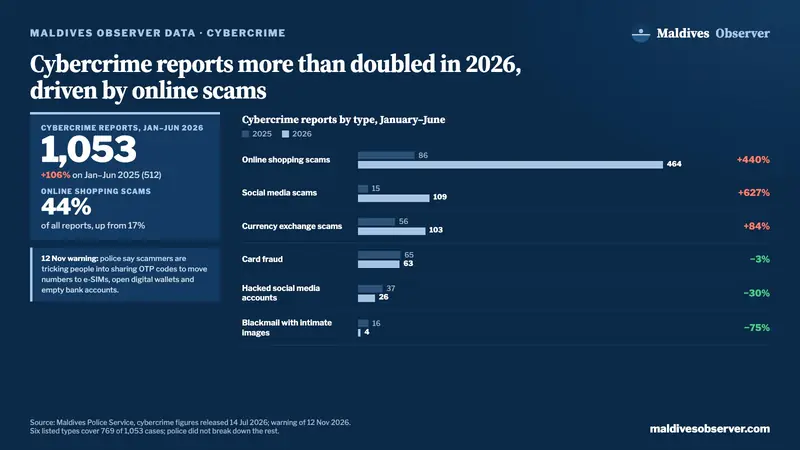
Police received 1,053 cybercrime reports from January to June 2026, up from 512 in the same months of 2025, an increase of 106 per cent, according to figures the Maldives Police Service released on 14 July.
The rise came from online fraud. By type, reports in the first half of the year were:
- Online shopping scams: 464, up from 86 (+440%)
- Social media scams: 109, up from 15 (+627%)
- Currency exchange scams: 103, up from 56 (+84%)
- Credit and debit card fraud: 63, down from 65 (-3%)
- Hacked social media accounts: 26, down from 37 (-30%)
- Blackmail using intimate images: 4, down from 16 (-75%)
Online shopping scams made up 44 per cent of all cybercrime reports in the first half of 2026, up from 17 per cent a year earlier. The six types police listed account for 769 of the 1,053 cases; police did not break down the remaining 284.
By mid-July, 884 cases were under investigation and 457 had been closed, a figure that includes some cases reported before 2026. Police said they had given technical help in 182 cases and helped recover 120 hacked Viber, WhatsApp and Facebook accounts.
Money lost
During Operation FRONTIER+ III, a joint anti-scam operation with police in nine other jurisdictions from 10 March to 7 May 2026, the police Anti-Scam Centre investigated 349 scam cases reported in the Maldives, with losses of MVR 4,025,424. Police froze 664 bank accounts linked to scams, recovered about MVR 1.16 million and arrested 16 men.
Police identified four main scam trends in the Maldives during that operation: fake online shops and marketplace listings; currency exchange and cryptocurrency scams; impersonation and phishing, including phone scams; and investment scams promising guaranteed returns.
What is not published
The police online crime statistics dashboard, which showed 10,710 cases reported in 2026 when checked on 13 November, has no category for fraud, scams or cybercrime; its 12 categories include theft, drugs and embezzlement. The most recent detailed quarterly crime report on the police website covers the last quarter of 2023. Police have not published a count of OTP or e-SIM scam cases.
Related data
All data trackersExplainers
- Maldives weather by month: rainfall, temperature, monsoons and sea conditions
- Maldives vape ban and tobacco rules: what is banned and what visitors can bring
- Velana International Airport in numbers: passengers, the new terminal and transfers