Three tax laws ratified: GST ends on overseas tourism bookings, interest cap cut, appeals need 50% upfront
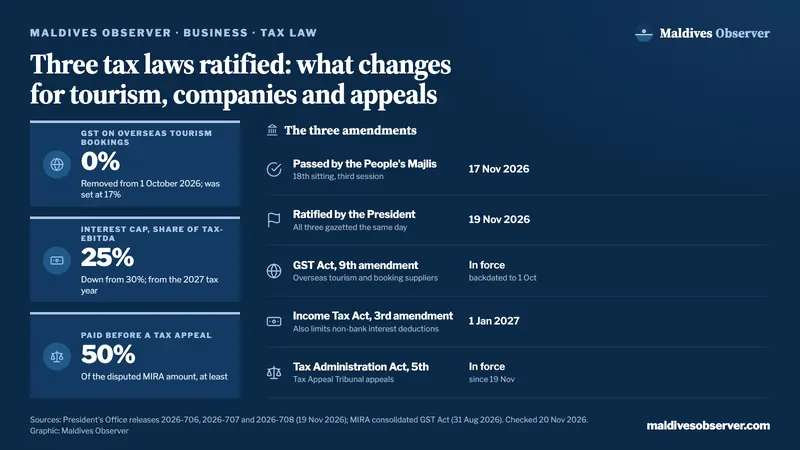
President Muizzu ratified amendments to the GST, Income Tax and Tax Administration Acts on 19 November 2026. They remove GST on tourism bookings sold by overseas firms from 1 October 2026, cut the thin capitalisation interest cap to 25% of tax-EBITDA from 2027, and require half of a disputed MIRA assessment to be paid before an appeal.

President Dr Mohamed Muizzu ratified three amendments to Maldivian tax law on 19 November 2026, two days after the People's Majlis passed them. One amendment removes GST on tourism bookings sold by overseas firms, backdated to 1 October 2026. Another lowers the cap on interest that companies can deduct from 30% to 25% of tax-EBITDA from the 2027 tax year. The third requires taxpayers to pay at least 50% of a disputed MIRA assessment before they can appeal it.
All three bills were passed at the 18th sitting of the Majlis's third session for 2026, on Tuesday 17 November. The GST and tax administration changes took effect on gazette publication. The income tax change takes effect on 1 January 2027.
The changes follow the 2027 budget. In its budget speech of 29 October 2026, the Ministry of Finance and Public Enterprises said that amendments to the tax laws had been put forward with the budget. Their aim was to strengthen tax administration and make sure that the state collects the tax it is owed in full. The same speech said no tax would be raised in 2027. It also confirmed that the GST registration threshold will rise from MVR 1 million to MVR 1.5 million in annual turnover from 1 January 2027. The 2027 budget is covered in more detail elsewhere.
What each law changes
| Law | What the amendment does | When it applies |
|---|---|---|
| Goods and Services Tax Act (10/2011), ninth amendment | Ends GST on inbound tourism products, and on agency or booking services linked to them, when a supplier with no permanent place of business in the Maldives sells them as part of tourism goods and services. It also gives MIRA more powers against GST evasion. | GST removal from 1 October 2026. In force since gazette publication on 19 November 2026. |
| Income Tax Act (25/2019), third amendment | Limits deductions for interest paid to anyone other than a financial institution. Cuts the thin capitalisation interest cap from 30% to 25% of tax-EBITDA. | 2027 tax year onwards. In force 1 January 2027. |
| Tax Administration Act (3/2010), fifth amendment | An appeal against a MIRA assessment to the Tax Appeal Tribunal can be lodged only after at least 50% of the disputed amount is paid. It sets out when the full amount must be paid first, and how penalties and interest on the disputed sum are treated. | In force since gazette publication on 19 November 2026. |
Source: President's Office releases 2026-706, 2026-707 and 2026-708, 19 November 2026.
GST: overseas booking firms
MIRA's consolidated GST Act, dated 31 August 2026, set out a new charge. From 1 October 2026, inbound tourism products sold by a supplier with no fixed place of business in the Maldives would be taxed at the tourism GST rate of 17%. Agency and booking services linked to them would be taxed at the same rate. The Dhivehi release from the President's Office describes the new amendment as stopping GST "that had been levied" on these supplies from that date. The charge therefore ends from the day it began.
The firms most directly affected are foreign travel agents, tour operators and online booking platforms that sell Maldives holidays from abroad. Resorts and guesthouses still charge tourism GST on the rooms, food and services they supply in the Maldives. Our explainer on tourist taxes sets out those charges. The release gave no detail on GST already paid since 1 October, or on the new enforcement powers.
Tourism GST is the largest tax line in the 2027 budget tables, which put it at MVR 12.13 billion next year, against MVR 6.25 billion from general GST.
Income tax: interest on loans
Under the thin capitalisation rule, a company's deduction for interest is capped at a share of its tax-EBITDA. Tax-EBITDA is profit for tax purposes before interest, tax, depreciation and amortisation. That share falls from 30% to 25%. A company with MVR 100 million in tax-EBITDA could deduct up to MVR 30 million in interest under the old cap, and up to MVR 25 million under the new one.
The amendment also limits deductions for interest paid to parties other than financial institutions. That mainly affects companies borrowing from shareholders, parent companies or related parties rather than from banks. The President's Office did not publish the new limit on non-bank interest. For how company and personal income tax works, see our guide to income tax in the Maldives.
Tax appeals: pay half first
The Tax Appeal Tribunal hears appeals against tax assessed by MIRA. Under the fifth amendment, a taxpayer can bring such an appeal only after paying MIRA at least half of the disputed amount. In some cases, set out in the law, the whole amount must be paid before an appeal. The amendment also explains how penalties and interest on the disputed amount are dealt with while the appeal is heard.
The rule applies to any business or individual that wants to challenge a MIRA assessment from 19 November 2026. The release did not say what the rule was before, or how it treats appeals already lodged.
Why it matters for revenue
The three laws ease one tourism charge and tighten two rules on collection. The 2027 budget puts tax revenue at MVR 33.64 billion, about 78% of revenue and grants, and tax on business profits, which the interest limits affect, at MVR 3.23 billion. Monthly collection figures are tracked on our government revenue page and in our October 2026 revenue report.
What happens next
- MIRA guidance. Any rules or circulars MIRA issues under the new laws will matter. Watch for guidance on refunds of GST charged since 1 October, and on the new limit for non-bank interest.
- Company tax returns for 2027. The interest limits apply first to the 2027 tax year. Companies with shareholder or group loans will see the effect in returns filed in 2028.
- Appeals at the Tribunal. The 50% payment rule applies now. The number of new appeals will show its effect.
Related data
All data trackersExplainers
- Income tax in the Maldives: rates, brackets, who files and tax clearance
- Maldives budget 2027 in numbers: revenue, spending, deficit and debt
- Maldives vape ban and tobacco rules: what is banned and what visitors can bring