Maldives 2.0: data exchange, smart ID and one health platform due within 18 months
President Muizzu said on 17 November 2026 that the Maldives Data Exchange will go live next year and health care will be fully digital by end-2027. What changes for citizens, what already exists and when each project is due.
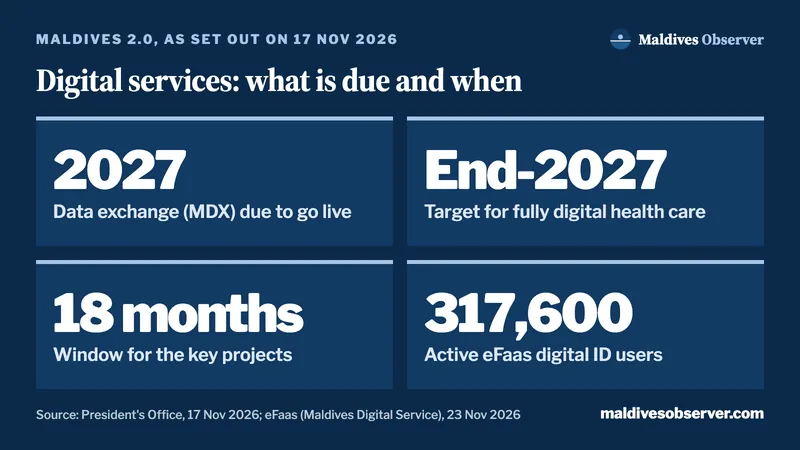
The government plans to finish its main digital public service projects within the next 18 months, President Mohamed Muizzu said on 17 November 2026. The list covers a Maldives Data Exchange (MDX) so that citizens no longer hand the same documents to one office after another, a smart national identity card, a single digital health platform and a national "Digital for All" literacy campaign. The MDX is expected to be in place next year, and health care is to be fully digitalised by the end of 2027, according to the President's Office.
The President set out the plans at the ceremony marking his Administration's third anniversary. He described the aim as wider public services delivered digitally, with less need for people to deal with officials in person. He said the government intends to complete a significant share of the work by the end of 2027, and that legislative work to support it is already under way.
The projects sit under Maldives 2.0, the programme launched at a digital transformation summit in Malé in May 2025. For a wider look at the Administration's record, see our data review of three years in office.
The four projects at a glance
| Project | What it does for citizens | Target date |
|---|---|---|
| Maldives Data Exchange (MDX) | Lets state institutions share verified records with each other, so people do not resubmit the same documents for each service | 2027 ("next year") |
| Smart national ID card | Turns the national identity card into a smart card used to reach public services | Within the 18-month window; no separate date given |
| Single digital health platform | One place to see health information and medical records, book appointments and view prescriptions; links hospitals and health centres | Full health digitalisation by end of 2027 |
| Digital for All | National campaign to build digital and artificial intelligence (AI) literacy | Announced; launch date not given |
Source: President's Office, 17 November 2026.
What already exists
Several building blocks are already live. The main one is eFaas, the national digital identity. Its website describes it as a way to prove who you are both online and in person, with one-tap and password-free login by QR code, biometric self-verification in the mobile app, and an inbox for notices from public agencies. On 23 November 2026 the eFaas site listed 172 digital service portals, 317,600 active users and 258,300 mobile app users. It still describes the service as being in "public preview". Work permit holders can also create an eFaas identity.
Online government services are gathered on oneGov (one.gov.mv), which lists services by government entity. In a notice dated 2 June 2026, the health ministry said services on its older Dhirithi portal were being moved to oneGov.
Other services have already gone digital under Maldives 2.0. Maldives Immigration became the first government agency to digitalise all its services in November 2025, the President's Office said at the time. Passport and visa services no longer need an in-person visit, and an e-Visa service, mobile app and facial recognition system were launched. Some National Social Protection Agency services had been digitalised by November 2025, the President said then. On 17 November 2026 the President's Office also opened the Citizens' Voice portal for complaints, run by the 24-hour Citizens' Complaints Bureau (how to use it).
The physical identity card has also moved closer to home. Card printing and issuance reached every atoll on 19 September 2025, ending with V. Felidhoo, the President's Office said.
Who is building it
On 15 January 2026 the President set up the Maldives Digital Service under the Ministry of Homeland Security and Technology and dissolved the National Centre for Information Technology (NCIT). The new agency took over all NCIT duties and leads the Maldives 2.0 Roadmap 2025–2028. It now develops and maintains eFaas, according to the eFaas website. In April 2026 the ministry was renamed the Ministry of Homeland Security, Labour and Technology.
Oversight sits with the Digital Transformation Council, chaired by the President and set up on 22 September 2025 to guide the roadmap.
The data exchange is moving through procurement. On 19 August 2026 the finance ministry, acting for the homeland security ministry, invited proposals to supply, customise, implement and integrate an MDX platform, with a closing date of 1 October 2026. The contract is part of the World Bank-financed Digital Maldives for Adaptation, Decentralization and Diversification (D'MADD) project, according to the gazette notice.
What changes in health care
Under the health plan, patients would use one platform to see their own health information and records, make appointments and check prescriptions. Hospitals and health centres would join a single system, so patient information can move between them. The President said this should make care easier to reach and reduce the difficulties patients face. The health ministry lists 23 government-run hospitals and 164 health centres.
Some health data is already online. The eFaas dashboard shows users their latest health insurance records. Aasandha Company, which runs the state health insurance scheme, offers its own mobile app.
The legal groundwork
In his February 2026 address to the People's Majlis, the President said a Digital Transformation Bill, a Digital Identity Bill and a Cybersecurity Bill would be submitted during that session. In the same address he said the citizenship card would be upgraded to a smart card. On 17 November he said legislative work for the new projects was under way.
What happens next
The next milestone is a contract award for the MDX platform and its launch, which the government expects in 2027. The President's Office has not yet given separate dates for the smart ID card or the Digital for All campaign. The health platform is due to be complete by the end of 2027. The Maldives Observer will track each project against these targets as agencies publish updates.
Explainers
- Maldives weather by month: rainfall, temperature, monsoons and sea conditions
- Maldives currency explained: the rufiyaa, the US dollar rate and how visitors can pay
- Maldives coral reefs in 2026: what the bleaching and recovery data show