Maldives coral reefs in 2026: what the bleaching and recovery data show
Central-atoll reefs lost more than 40% of their live coral in the 2024 bleaching, while reefs in the far south gained coral. Heat stress in 2026 stayed below the alert level. Here is the data, the recovery record and the rules for visitors.
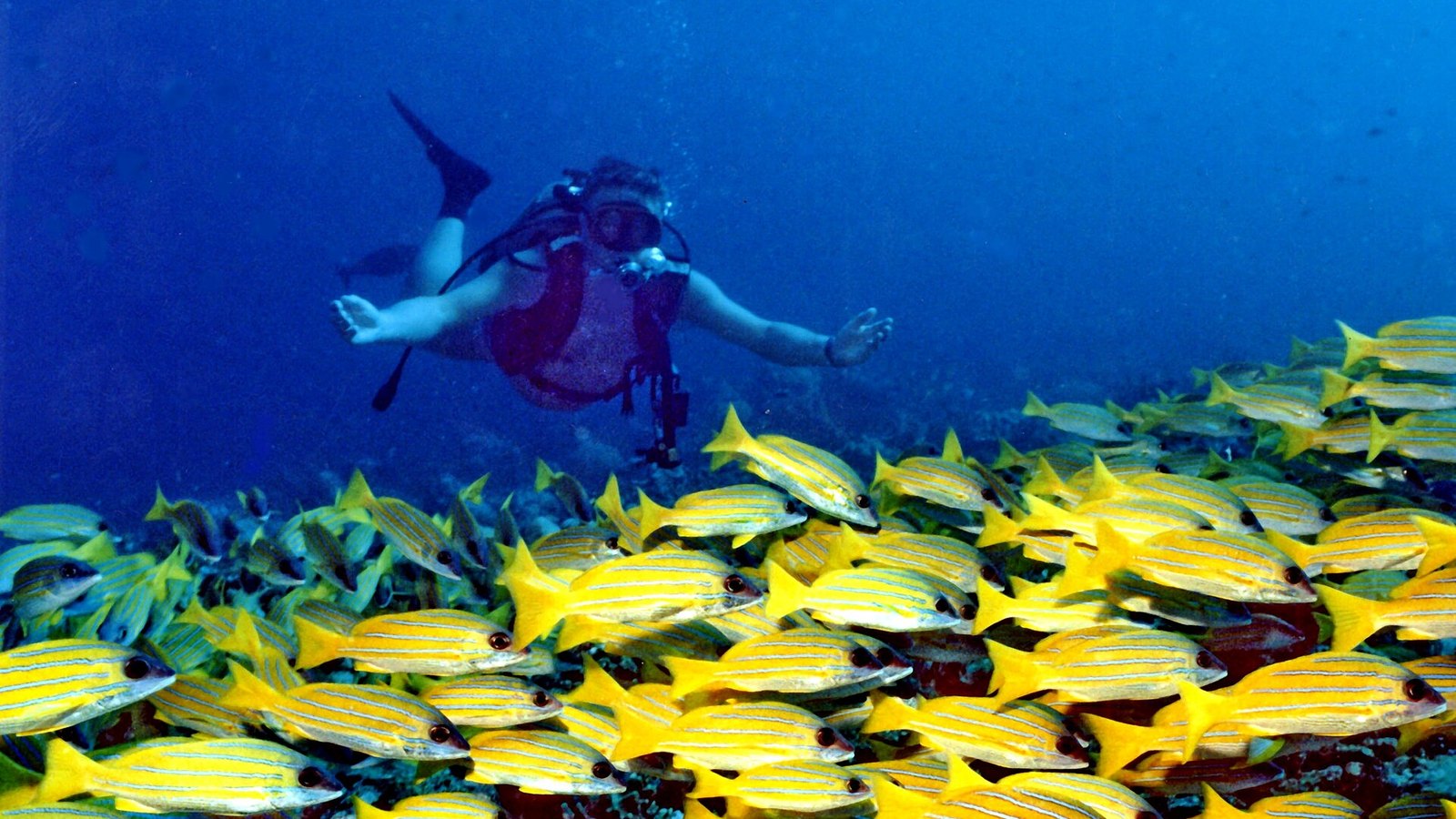
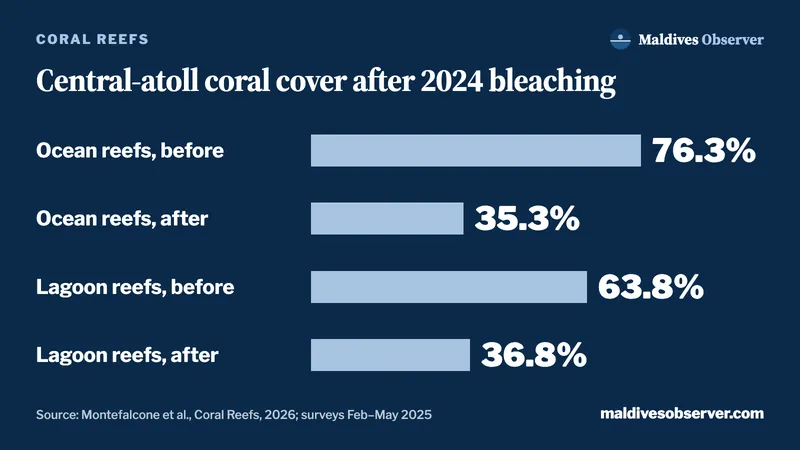
The coral reefs of the Maldives are alive, but the central atolls lost a large share of their coral in the 2024 bleaching. Surveys in early 2025 found live hard coral cover on central-atoll ocean reefs had fallen from 76.3% to 35.3%. Reefs in Huvadhoo Atoll in the south showed no detectable loss and had more coral than before. In 2026 the sea did not get hot enough to trigger a bleaching alert.
This page brings together the published data on bleaching and recovery: a 2026 study in the journal Coral Reefs, the Global Coral Reef Monitoring Network's report released in August 2026, NOAA Coral Reef Watch satellite data, and reports by the Maldives Marine Research Institute. It also lists the rules visitors must follow.
Maldives reefs in numbers
| Measure | Figure | Date |
|---|---|---|
| Coral reefs in the Maldives | 2,041 reefs covering 4,513 sq km | Satellite survey published 2004 |
| Coral cover, central-atoll ocean reefs | 76.3% before bleaching, 35.3% after | Surveyed February to May 2025 |
| Coral cover, central-atoll lagoon reefs | 63.8% before, 36.8% after | Surveyed February to May 2025 |
| Coral cover, Huvadhoo Atoll ocean reefs | 42.3% in 2021, 65.8% in 2025 | 2021 and 2025 |
| Peak heat stress in 2024 | 9.13 degree heating weeks | 18 May 2024 |
| Peak heat stress in 2026 | 3.21 degree heating weeks | 4 May 2026 |
| NOAA status for the Maldives | Bleaching Watch, no heat stress building | 18 November 2026 |
Sources: Montefalcone and others, Coral Reefs, March 2026; NOAA Coral Reef Watch; Naseer and Hatcher, Coral Reefs, 2004.
What happened in 2024
The fourth global bleaching event reached the Maldives in April and May 2024. Corals bleach when the water stays too warm for too long: they expel the algae that feed them and turn white. If the heat lasts, they die. Scientists measure the build-up of heat in degree heating weeks. NOAA says reef-wide bleaching becomes likely above 4, and heat-sensitive corals start to die above 8. The Maldives reached 9.13 on 18 May 2024.
A team from the University of Genoa and Save the Beach Maldives surveyed 18 shallow reefs between February and May 2025 and compared them with earlier surveys. Their findings, published in Coral Reefs in March 2026:
- In North Malé, South Malé, Felidhoo and Ari atolls, live hard coral cover fell by more than 40% on average.
- The worst loss, 57%, was on a lagoon reef in Ari Atoll.
- Branching and table corals of the Acropora group were hit hardest. Slower-growing boulder corals survived better.
- In Huvadhoo Atoll, no coral death was detected, and cover rose by 12 to 23 percentage points from 2021.
The authors said the 2024 event matched the reach of the 2016 bleaching and approached the intensity of 1998. They recommend protecting the resilient southern reefs as a refuge.
The government acted during the heat. In its report to the International Coral Reef Initiative, the Maldives said coastal development projects were advised to pause work that could stress reefs, and no new projects received permits to start until the alert was lifted.
Was there bleaching in 2026?
Heat stress in 2026 stayed well below the danger level. NOAA's satellite station for the Maldives peaked at 3.21 degree heating weeks on 4 May 2026. That put the country at Bleaching Warning, the stage where bleaching is possible, but under the threshold of 4 where reef-wide bleaching is expected. In 2025 the peak was 0.29.
On 18 November 2026 the station stood at Bleaching Watch with no accumulated heat stress. No field survey of reef condition for 2026 has been published yet.
Three bleaching events compared
| Year | Peak heat stress (degree heating weeks) | Recorded effect |
|---|---|---|
| 1998 | 8.79 | Coral cover at central sites fell from about 40% to under 2% |
| 2016 | 10.91 | 73% of corals bleached across 71 surveyed sites in 11 atolls |
| 2024 | 9.13 | Central-atoll cover down more than 40% on average; south unaffected |
Sources: NOAA Coral Reef Watch; Pisapia and others, Scientific Reports, 2016; Marine Research Centre and IUCN, 2017; Montefalcone and others, 2026. The 2016 figure counts corals that bleached, not corals that died.
Do the reefs recover?
They have recovered before. After 1998, coral cover at monitored sites in the central Maldives fell to 1.69%. It was back to 37.4% by 2009 and 42.1% by 2012, above its 1997 level. The researchers said recovery took up to a decade.
The Global Coral Reef Monitoring Network reached a similar finding in its Status of Coral Reefs of the World report, published on 31 August 2026. For the Maldives and Lakshadweep region it found coral cover of 44.9% in 1997, 7.3% in 2000 and 35.5% in 2015, with recovery again between 2018 and 2024. Its data stop before the effects of the 2024 event could be measured.
The risk is in the gaps between events. Reefs needed about ten years to recover from 1998, and the last two severe events came eight years apart. The same report says sea surface temperature over South Asia's reefs rose by 0.79°C between 1985 and 2025. The wider picture is in our explainer on sea level and climate in the Maldives.
Restoration work
The Maldives Marine Research Institute runs a five-year coral restoration programme with Australian partners. In April 2025 its team at Maniyafushi in South Malé Atoll collected coral spawn and raised more than three million larvae from four coral species. They placed more than 10,000 young corals on nine reefs, the Australian Institute of Marine Science reported. The project has USD 1.5 million over three years from a G20 coral research fund.
The institute has monitored reefs since 1998 and had 57 long-term monitoring sites by the end of 2021. All restoration projects need a government permit.
Rules for visitors
- Do not take coral. The General Fisheries Regulation prohibits taking, harming, buying or selling coral, whether alive or dead.
- Do not carry coral out of the country. Export of corals is prohibited.
- Do not touch or stand on coral. The diving regulation requires divers to be briefed on avoiding damage to corals and contact with marine animals.
- In marine protected areas the rule is "look but don't touch", and only permitted activities are allowed.
- Dive boats may not anchor on dive sites.
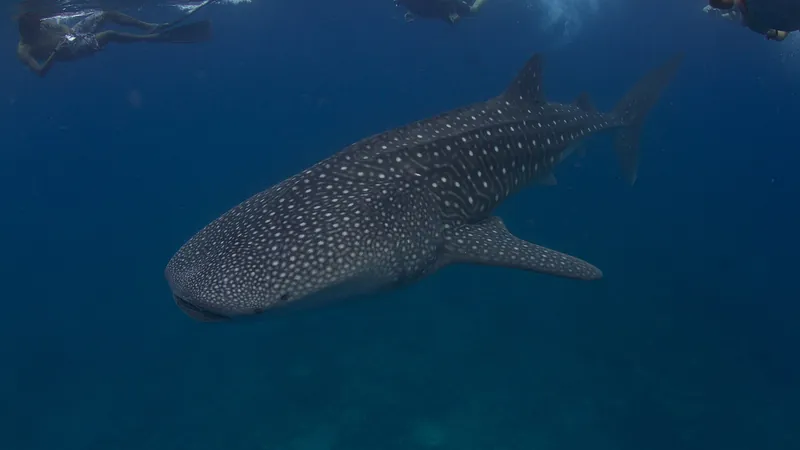
The Maldives has 93 protected areas on the government register. They include the Baa Atoll UNESCO Biosphere Reserve, home of Hanifaru Bay. Our guide to whale shark and manta ray season covers the rules there.
Frequently asked questions
Is the Maldives reef dead?
No. Surveys in 2025 found live coral cover of about 35% to 37% on central-atoll reefs after the 2024 bleaching, and 66% to 77% on surveyed reefs in Huvadhoo Atoll.
Was there coral bleaching in the Maldives in 2026?
Heat stress peaked at 3.21 degree heating weeks in May 2026, below the level of 4 at which reef-wide bleaching is expected. No bleaching alert was reached.
How bad was the 2024 bleaching?
Live hard coral cover on surveyed central-atoll reefs fell by more than 40% on average. Reefs surveyed in the far south were not affected.
Do Maldives reefs recover after bleaching?
They did after 1998. Coral cover at central sites returned to its earlier level by 2012, about a decade later.
Can I take coral home from the Maldives?
No. Taking, buying and exporting coral is prohibited, including dead coral picked up on a beach.