Is the Maldives sinking? Sea level and climate in numbers
How high the Maldives sits above the sea, how fast the sea is rising, what the IPCC projects for 2100, what bleaching has done to the reefs, and what the monsoon seasons bring, from official and scientific sources.
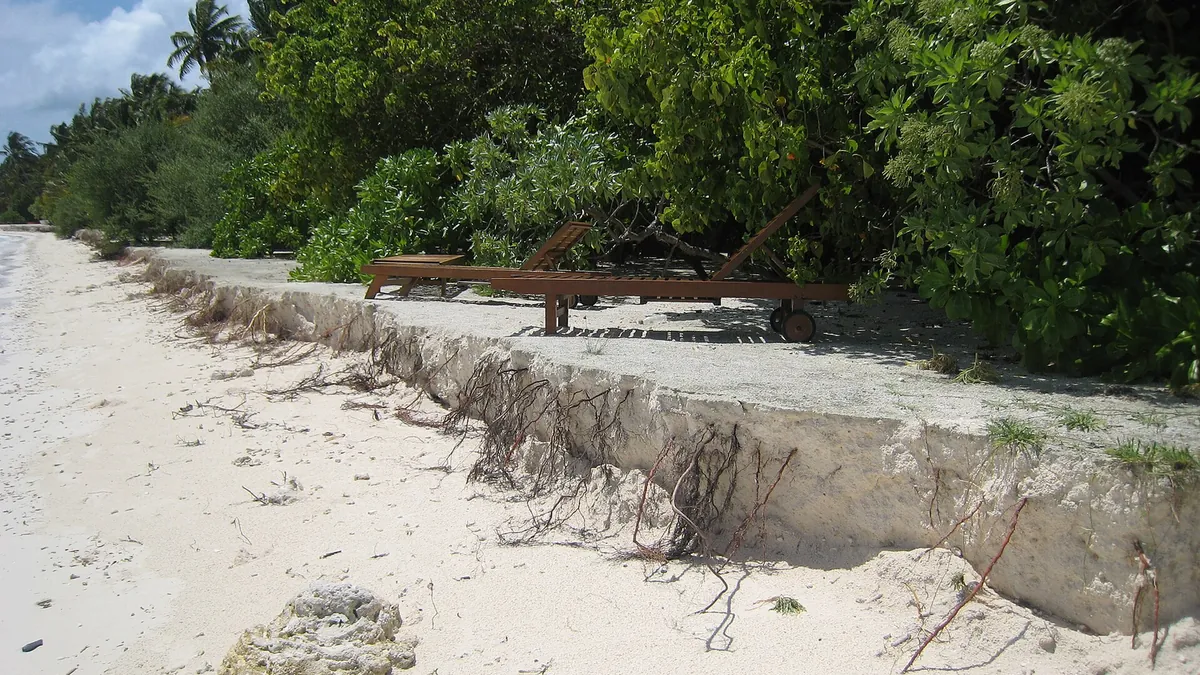
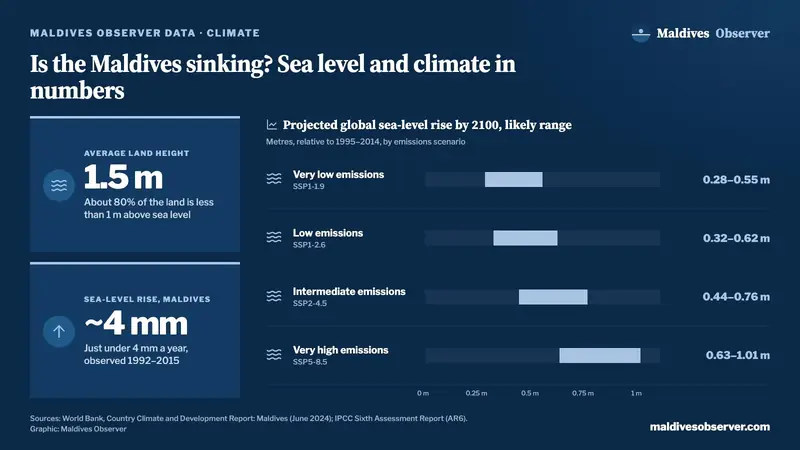
The Maldives is not sinking, but the sea around it is rising. The World Bank puts average land elevation at 1.5 metres. About 80 per cent of land is less than 1 metre above sea level. Local sea level rose by just under 4 mm a year in 1992–2015. The IPCC projects a global rise of 0.28–1.01 metres by 2100.
The numbers at a glance
| Measure | Figure | Period or date | Source |
|---|---|---|---|
| Average land elevation | 1.5 m above sea level | June 2024 report | World Bank |
| Land less than 1 m above sea level | About 80% | June 2024 report | World Bank |
| Observed sea-level rise, Maldives | Just under 4 mm a year | 1992–2015 | World Bank |
| Global sea-level rise since 1901 | 0.20 m | 1901–2018 | IPCC AR6 |
| Projected global rise by 2100 | 0.28–1.01 m (likely range) | Relative to 1995–2014 | IPCC AR6 |
| Coral cover loss after 2016 bleaching | 75% on average | 2016, southern atolls | Perry and Morgan, Scientific Reports |
| Average temperature range | 25°C to 32°C | Long-term | Maldives Meteorological Service |
| Average annual rainfall, whole country | 2,109 mm | 1991–2020 | Maldives Meteorological Service |
How low the islands are
The World Bank's Country Climate and Development Report, published in June 2024, describes 1,192 coral islands with 298 square kilometres of land, spread across 26 atolls. It gives an average elevation of 1.5 metres, the lowest of any country, with about 80 per cent of land less than 1 metre above mean sea level. It puts Malé at an average of 3 metres above sea level and Hulhumalé at about 2 metres.
The same report finds that over 40 per cent of people, and 36 per cent of buildings, are within 100 metres of the shore.
Sea level: observed and projected
According to the World Bank, sea level around the Maldives rose by an average of just under 4 mm a year between 1992 and 2015. Worldwide, the IPCC's Sixth Assessment Report (AR6) finds that global mean sea level rose by 0.20 metres between 1901 and 2018. The rate rose to 3.7 mm a year in 2006–2018.
The IPCC's likely ranges for global rise by 2100, compared with 1995–2014, depend on how much greenhouse gas the world emits:
- very low emissions (SSP1-1.9): 0.28–0.55 m
- low emissions (SSP1-2.6): 0.32–0.62 m
- intermediate emissions (SSP2-4.5): 0.44–0.76 m
- very high emissions (SSP5-8.5): 0.63–1.01 m
The IPCC adds that a rise approaching 2 metres by 2100 cannot be ruled out under very high emissions, because ice-sheet behaviour is deeply uncertain.
The World Bank's own modelling for the Maldives finds that, under severe warming, the local rate could reach 6 to 12 mm a year. The summary of its report gives a rise of 0.5 to 0.9 metres by 2100, while the main text says "up to 1 m". Both are measured against 1995–2014.
Coral reefs and bleaching
Reefs shield islands from waves and supply the sand they are built from. Bleaching happens when water stays too warm for too long and corals lose the algae they live on. According to the World Bank, the 1998 bleaching event cut coral cover from more than 70 per cent to less than 10 per cent. The reefs recovered to nearly earlier levels before the next major event in 2016.
A study by C. T. Perry and K. M. Morgan in the journal Scientific Reports (January 2017) measured the 2016 event on reefs in the southern Maldives. They found an average 75 per cent fall in coral cover, to a mean of 6.2 per cent. The reefs' growth potential fell from 4.2 mm a year to minus 0.4 mm a year. The World Bank's modelling suggests almost all coral cover could be lost if global warming exceeds 2°C.
Seasons, temperature and rainfall
The Maldives Meteorological Service describes two seasons:
- the southwest monsoon (wet season), normally from mid-May to November
- the northeast monsoon (dry season), from January to March
December and April are transition months. Average temperatures range from 25°C to 32°C, and the warmest period runs from March to mid-May. The highest temperature on record is 36.0°C, at L. Kadhdhoo on 12 September 1991. The lowest is 18.2°C, at HDh. Hanimaadhoo on 23 December 2002.
Rainfall increases from north to south. The service gives average annual rainfall of about 1,779 mm in the northern atolls, 1,966 mm in the central atolls and 2,218 mm in the southern atolls. For the country as a whole, the 1991–2020 average was 2,109 mm.
Why "underwater by year X" claims are unreliable
- Projections are ranges, not dates. The IPCC's figures depend on future emissions, and even its highest likely range is about 1 metre by 2100.
- Islands are not fixed. The World Bank, citing a 2020 study by V. K. Duvat in the journal Anthropocene, reports that between 2004 and 2016, 59 per cent of islands grew in area, 38 per cent stayed stable and 3 per cent shrank. Reef sand and land reclamation both played a part.
- Flooding varies island by island. A 2022 study in Scientific Reports by A. Amores, M. Marcos, G. Le Cozannet and J. Hinkel found that nearby islands can face similar wave flooding decades apart. Waves and the shape of each island matter, not just average sea level.
The risk is more frequent flooding and damage to reefs, not a single day when the country disappears.
Frequently asked questions
Is the Maldives sinking?
No. The land is not sinking. The sea is rising, by just under 4 mm a year between 1992 and 2015 according to the World Bank, and the islands sit very close to sea level.
How high above sea level is the Maldives?
The World Bank gives an average land elevation of 1.5 metres, with about 80 per cent of land less than 1 metre above mean sea level.
Will the Maldives be underwater by 2100?
No reliable source gives a date. The IPCC projects a global rise of 0.28 to 1.01 metres by 2100, depending on emissions. How much flooding increases depends on each island and on adaptation.
When is the rainy season in the Maldives?
The southwest monsoon, normally from mid-May to November, is the wetter season, according to the Maldives Meteorological Service. January to March is the drier northeast monsoon.
How badly has coral bleaching hit the Maldives?
After the 2016 event, coral cover on studied southern reefs fell by 75 per cent on average, according to a study in Scientific Reports. The World Bank says the 1998 event cut cover from over 70 per cent to under 10 per cent.
Figures last checked on 13 November 2026. We update this page when new official figures are released.