Best time to visit the Maldives: weather, prices and crowds month by month
January to April is the driest and sunniest time in the Maldives, and also the busiest. A month-by-month table of rain, sunshine, tourist arrivals and bed occupancy, from Meteorological Service and tourism ministry data.
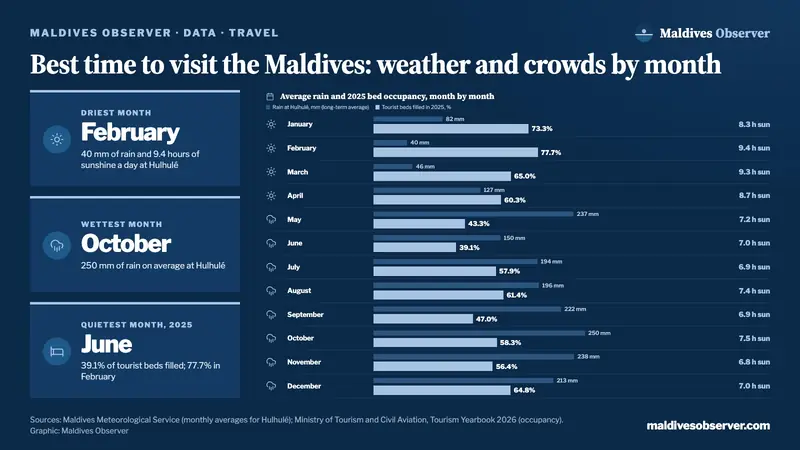
January to April is the driest and sunniest time to visit the Maldives, and February stands out: about 40 mm of rain and more than nine hours of sunshine a day near Malé. It is also the busiest time, with 77.7% of tourist beds filled in February 2025. May, June and September are wetter and much quieter.
The numbers at a glance
| Measure | Figure | Date |
|---|---|---|
| Driest month at Hulhulé (Malé airport) | February, 40.0 mm of rain | Long-term monthly average |
| Wettest month at Hulhulé | October, 250.2 mm of rain | Long-term monthly average |
| Sunniest month at Hulhulé | February, 9.4 hours a day | Long-term monthly average |
| Average temperature range | 25°C to 32°C all year | Undated climate page |
| Busiest month for arrivals | December, 224,455 tourists | 2025 |
| Quietest month for arrivals | May, 135,614 tourists | 2025 |
| Highest bed occupancy | February, 77.7% | 2025 |
| Lowest bed occupancy | June, 39.1% | 2025 |
The Maldives month by month
The weather columns are the Maldives Meteorological Service's long-term averages for Hulhulé, the airport island beside Malé. The Service's climate page does not state the years the averages cover. Sunshine is its monthly total divided by the days in the month. Arrivals and occupancy are Ministry of Tourism and Civil Aviation figures for 2025, the latest full year.
| Month | Rain (mm) | Sunshine (hours a day) | Tourist arrivals, 2025 | Bed occupancy, 2025 |
|---|---|---|---|---|
| January | 81.8 | 8.3 | 214,863 | 73.3% |
| February | 40.0 | 9.4 | 214,091 | 77.7% |
| March | 46.5 | 9.3 | 203,468 | 65.0% |
| April | 126.6 | 8.7 | 198,322 | 60.3% |
| May | 236.8 | 7.2 | 135,614 | 43.3% |
| June | 150.3 | 7.0 | 141,772 | 39.1% |
| July | 194.2 | 6.9 | 186,738 | 57.9% |
| August | 195.9 | 7.4 | 192,058 | 61.4% |
| September | 222.1 | 6.9 | 149,563 | 47.0% |
| October | 250.2 | 7.5 | 190,445 | 58.3% |
| November | 237.5 | 6.8 | 195,127 | 56.4% |
| December | 212.9 | 7.0 | 224,455 | 64.8% |
Weather: two monsoons, and a north to south difference
The Meteorological Service describes two seasons. The northeast monsoon, the dry season, runs from January to March. The southwest monsoon, the wet season, normally runs from mid-May to November. December and April are transition months.
Temperature hardly changes. The Service gives an average range of 25°C to 32°C, with the warmest spell in March and April and up to the start of the southwest monsoon in mid-May. Rain is the real variable. Even in the wet season, the Service says, rain usually falls as showers that do not last long, with sunny periods in between. Hulhulé still averages about seven hours of sunshine a day from May to December.
Where you stay matters as well:
- North. At HDh. Hanimaadhoo, average rain stays below 65 mm in each month from January to April. June and July are wetter there than at Hulhulé, at 222.7 mm and 259.1 mm.
- South. At S. Gan, in Addu City, January averages 202.0 mm and February 75.9 mm. The far south has no month as dry as the north's dry season.
- Annual totals. The Service puts average yearly rainfall at about 1,779 mm in the northern atolls, 1,966 mm in the central atolls and 2,218 mm in the south.
Averages are not forecasts. In 2025 Malé recorded 445.4 mm of rain in January, more than five times the average for the month, and only 17.2 mm in September, according to Meteorological Service data in the Statistical Yearbook 2026.
Crowds and prices
We found no official price index for resort or guesthouse rooms, so this page does not quote prices. The official measure of demand is bed occupancy: the share of available tourist beds that were filled across resorts, hotels, guesthouses and safari vessels.
The ministry says peak occupancy lasts from November to April and the low season runs from May to July. It links the peak to the festive season in Europe and the Chinese New Year holidays. In 2025 occupancy was 73.3% in January and 77.7% in February, then fell to 43.3% in May and 39.1% in June. It recovered to 61.4% in August before dipping to 47.0% in September. Average stays ranged from 6.6 days in May to 7.5 days in July.
When more beds are empty, there is more room to choose where to stay. Whether that means lower prices on a given date depends on the property, and the official data do not show it.
Arrivals follow a similar curve, but December brought the most visitors in 2025, at 224,455. February 2026 was higher still, at 247,722. Current counts are on our tourist arrivals data page, and the Maldives travel guide for 2026–27 covers entry rules, moving between islands and local customs.
Frequently asked questions
What is the best month to visit the Maldives?
For dry, sunny weather, February and March: Hulhulé averages under 50 mm of rain and more than nine hours of sunshine a day in both months. They are also among the busiest months.
When is the rainy season in the Maldives?
The southwest monsoon normally runs from mid-May to November. At Hulhulé, May and September to November each average more than 220 mm of rain.
Does it rain all day in the wet season?
Usually not. The Meteorological Service says rain normally comes as showers that do not last long, with sunny periods in between.
When is the Maldives least crowded?
June had the lowest bed occupancy in 2025, at 39.1%, followed by May at 43.3% and September at 47.0%. May had the fewest arrivals, at 135,614.
Is July or August a good time to go?
Both fall in the wet season, with about 195 mm of rain and around seven hours of sunshine a day at Hulhulé. They are busier than May or June: occupancy was 57.9% in July 2025 and 61.4% in August.
How hot is the Maldives?
The average temperature ranges from 25°C to 32°C through the year. The highest temperature on record is 36.0°C, measured at L. Kadhdhoo on 12 September 1991.
Figures last checked on 14 November 2026. We update this page when new official figures are released.