What the Ras Malé deal with Eagle Hills promises the Maldives
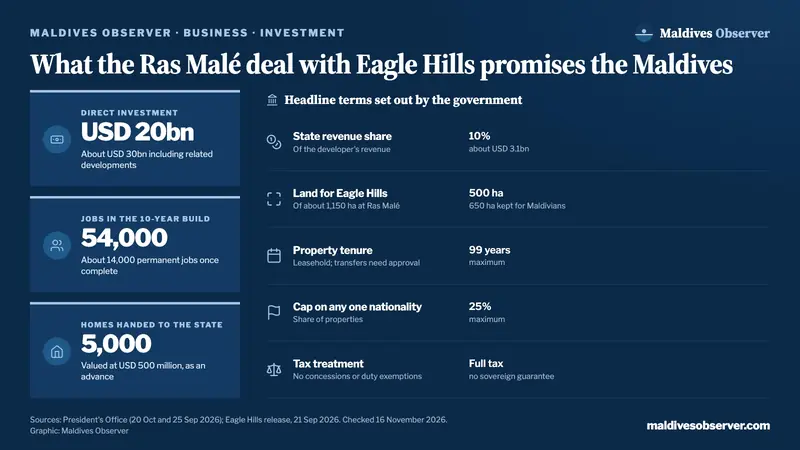
The government says the Eagle Hills development at Ras Malé will bring USD 20 billion of direct investment, 54,000 jobs during construction, 5,000 housing units and a 10 per cent revenue share worth about USD 3.1 billion. These are the commitments and who made them.
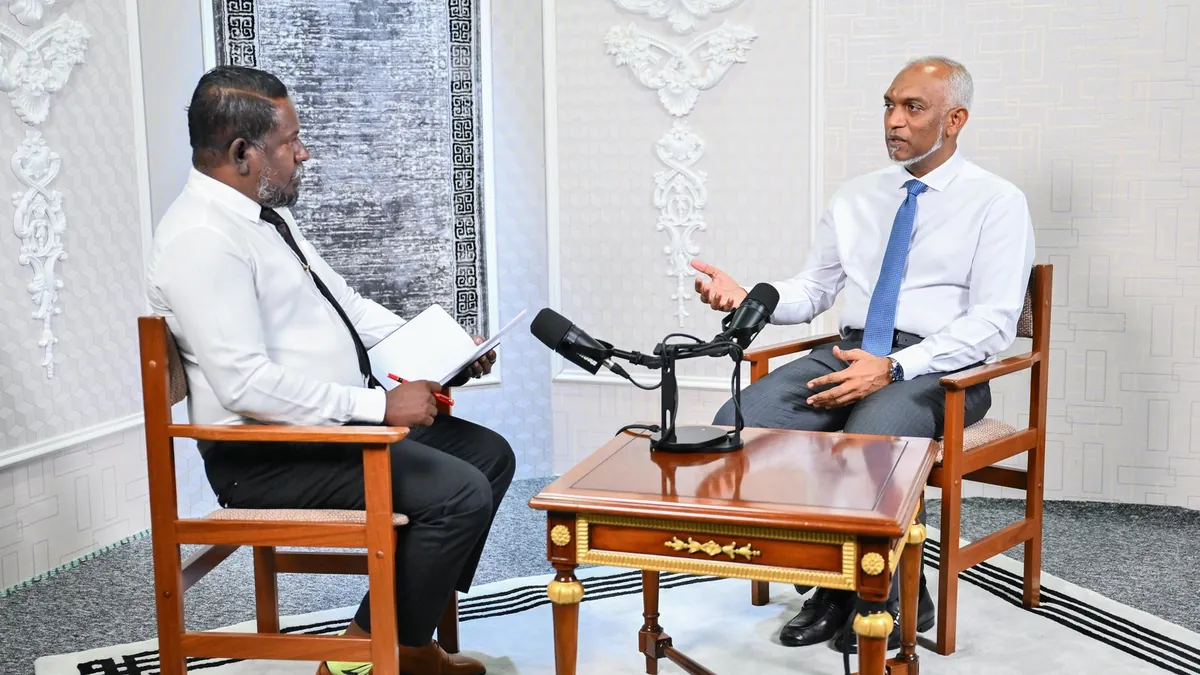
The government says its Ras Malé deal with Abu Dhabi developer Eagle Hills will bring USD 20 billion of direct investment, 5,000 housing units for the state and a 10 per cent share of the developer's revenue, which President Dr Mohamed Muizzu has put at about USD 3.1 billion. The President set out those figures on 20 October 2026, a month after the two sides signed a commercial terms agreement for a project called Maldives Waterfront and Marina.
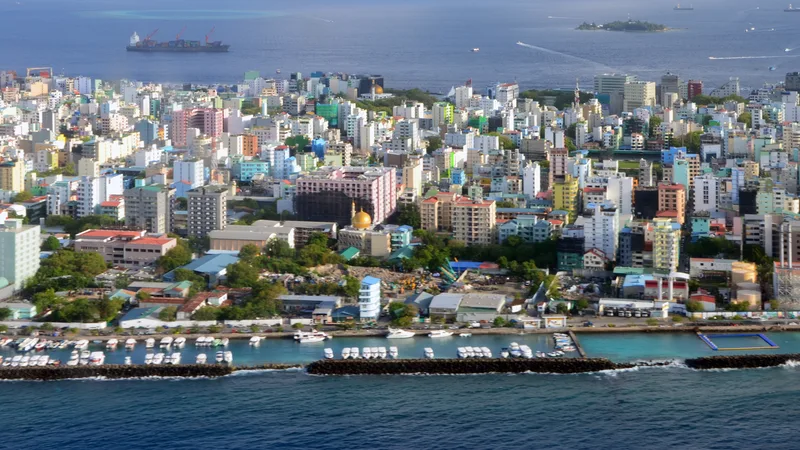
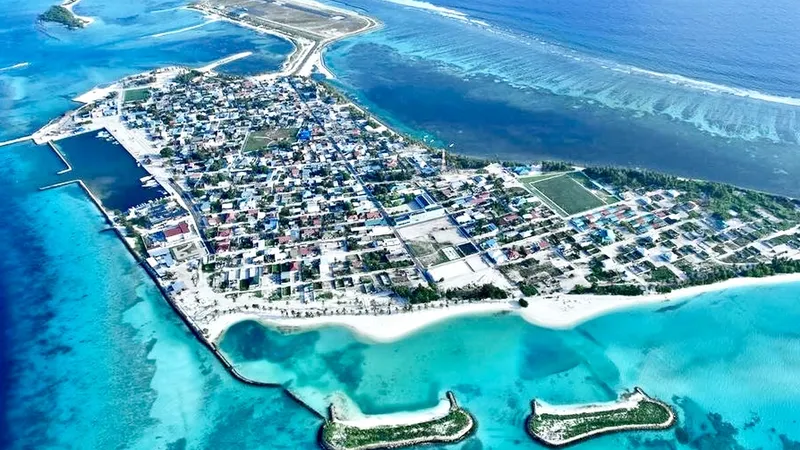
Ras Malé is the city being built on reclaimed land in the Fushidhiggaru lagoon, in K. (North Malé) Atoll, close to the capital. The President's Office said at its launch on 18 December 2023 that it would add 1,153 hectares, about three times the area of both phases of Hulhumalé. On 25 September 2026 the President said 60 to 70 per cent of the reclamation was done. Under the deal, Eagle Hills is to develop about 500 hectares. The President said on 20 October that the remaining 650 hectares or so would be kept for Maldivians.
The headline commitments
| Commitment | Figure | Stated by, date |
|---|---|---|
| Direct investment in the project | USD 20 billion | President, The Pulse podcast, 20 Oct 2026 |
| Total investment, including related developments | About USD 30 billion | President's Office, 20 Oct 2026 (an Eagle Hills estimate) |
| Jobs during the 10-year development phase | 54,000 | President, 20 Oct 2026 |
| Permanent jobs once complete | About 14,000 | President's Office, 20 Oct 2026 |
| Housing handed to the state as an advance | 5,000 units, valued at USD 500 million | President, 20 Oct 2026 |
| State share of developer revenue | 10 per cent, about USD 3.1 billion | President, 20 Oct 2026 |
| Land for the developer | About 500 of about 1,150 hectares | President, 20 Oct 2026 |
| Property tenure | Leasehold of up to 99 years; every transfer needs government approval | Eagle Hills release, 21 Sep 2026 |
| Tax treatment | No tax concessions, duty exemptions or sovereign guarantees | President, 25 Sep 2026 |
| Limit on any one nationality | No more than 25 per cent of properties | President, 20 Oct 2026 |
Sources: President's Office press releases and published transcripts; Eagle Hills. The Dhivehi transcript of the 20 October interview gives 15,000 permanent jobs and USD 31 billion in total investment.
Investment without borrowing
The government presents the deal as foreign capital that adds nothing to public debt. In the Eagle Hills release announcing the agreement, the infrastructure and housing minister, Dr Abdulla Muththalib, called it "the largest investment programme in our history". He said the money would move through the Maldivian banking system and bring direct revenue to the state from every sale, "without tax giveaways and without government borrowing". For the state of the country's borrowing, see our analysis of Maldives public debt and GDP.
The President has also compared the deal with the resort model. On 20 October he said that leasing the same land for 99 years on current resort-island terms would earn the state at most USD 514 million. That is about one-sixth of the USD 3.1 billion revenue share (our calculation) he expects from Eagle Hills, before counting the 5,000 homes. The minister described a new real estate sector as "a new pillar of our economy standing alongside tourism" and part of the goal of becoming a high-income country by 2040.
Housing and infrastructure
Housing was the reason Ras Malé was started. In December 2023 the President said Ras Malé, together with new land at Gulhifalhu and Giraavaru Falhu, would provide 65,000 housing plots or flats for the Malé region. The Eagle Hills deal adds 5,000 units, which the President described as an advance payment to the state, and on 28 October he said foreign investment would not reduce housing for eligible Maldivian applicants.
He also said the project would speed up services for the Maldivian side. Because the development will buy its power and utilities from the government, he said on 28 October, companies have offered to supply electricity, water and sewerage for the whole of Ras Malé. The remaining 650 hectares would therefore not have to wait years for utilities, which he said had happened in Hulhumalé. The President's Office has described Ras Malé as a low-carbon eco-city built above projected sea-level rise and powered by renewable energy.
Tourism and the wider economy
Eagle Hills says the destination will combine hotels and resorts, premium and branded residences, a marina, waterfront promenades, retail, dining and wellness, plus schools, healthcare and public space. It expects the project to broaden the tourism offer and attract new kinds of visitors. It also expects growth in hospitality, construction, retail, marine services and technology, with "significant" tax contributions and jobs for Maldivians in local supply chains. The developer says it will build only on reclaimed land, do no further dredging and accept independent marine monitoring during construction.
Safeguards the government has set out
The President has said repeatedly that no land will be sold: properties will be leased under Maldivian law, and ownership will not pass to foreigners. He said on 20 October that buyers from any single country would be capped at 25 per cent of the properties and that Israeli nationals would be barred from buying. Maldivian law would apply in full across the area. He also said dedicated legislation for the project would be drafted, sent to Parliament and made public.
The deal faces criticism from the opposition, and a protest against it is planned for 4 December.
What happens next
- The final agreement. The September document sets out the principal commercial terms only. Eagle Hills says the detailed terms will follow as the project progresses.
- Parliament. The President has said the project law will go to Parliament and that its committees will scrutinise the project.
- Construction. Neither the President's Office nor Eagle Hills has published a construction start date. The President has said the development phase will run for about 10 years.
- Reclamation. The rest of the lagoon must be filled before building can start.
Explainers
- Who is the President of the Maldives? Muizzu, the Vice President and the cabinet
- Maldives public debt and GDP in numbers
- Maldives weather by month: rainfall, temperature, monsoons and sea conditions