Real Estate Development Bill: escrow for flat buyers, 99-year leases in big zones
The government's bill creates a property regulator, protects buyers' payments in escrow and sets the rules for large integrated real estate zones, where foreigners can hold leases of up to 99 years but not freehold.
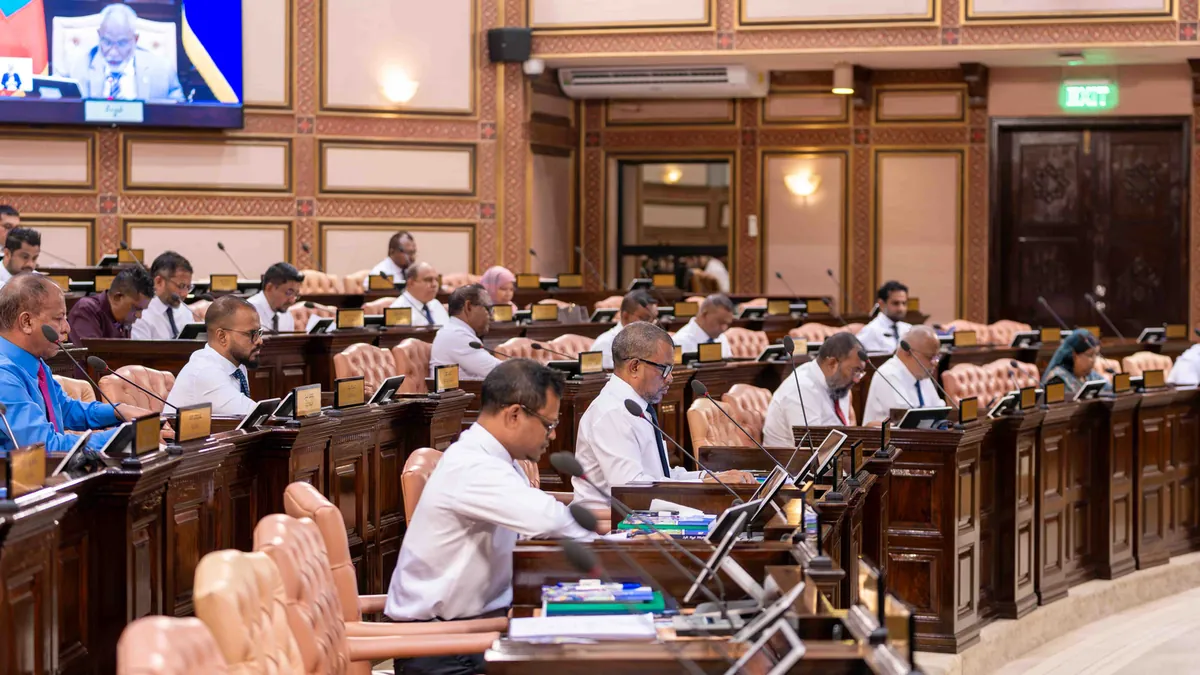
The government's Real Estate Development Bill, now before the People's Majlis, would bring apartment developers and property agents under a single regulator and protect buyers' money in escrow. It would also set the legal rules for large "integrated real estate zones" such as the one planned at Ras Malé. The bill, No. 20/2026/B-38, was sponsored on the government's behalf by the MP for North Henveyru, Ahmed Aifan. It had its first reading on 9 November 2026 and was debated on 16 November.
For foreign investors, the bill offers long leases, not ownership. Property in the zones can be sold only as leasehold rights for up to 99 years, in line with Article 251 of the Constitution, which bars any foreign party from owning Maldivian land.
What the bill does for buyers at home
Most of the bill is about ordinary flat and housing projects, not just the large zones. It would set up a Property Regulatory Authority under the ministry, led by a chief executive appointed by the President (sections 35 to 37). Every developer would have to register with the authority, and so would each project (sections 48 and 49). No project could be advertised or sold, and no money taken for it, until it is registered (section 50).
Buyers who pay for a flat before it is built get the most protection:
- Escrow: payments from off-plan buyers go into the project's escrow account at a bank, and are released to the developer in stages as construction is certified (sections 53 and 56).
- Retention: 5% stays in escrow for one year after handover (section 56).
- Contracts: the sale agreement must set out the payment schedule, the handover date and what happens if the developer is late (section 51).
- Delays and refunds: developers must tell buyers and the authority about delays in writing. Buyers' money must be refunded if a project fails or its registration is cancelled (sections 58 and 59).
Property agents and valuers would also need a licence from the authority (chapter 10). Complaints go to the authority, which must decide them within 90 days (section 142).
Integrated real estate zones: the main terms
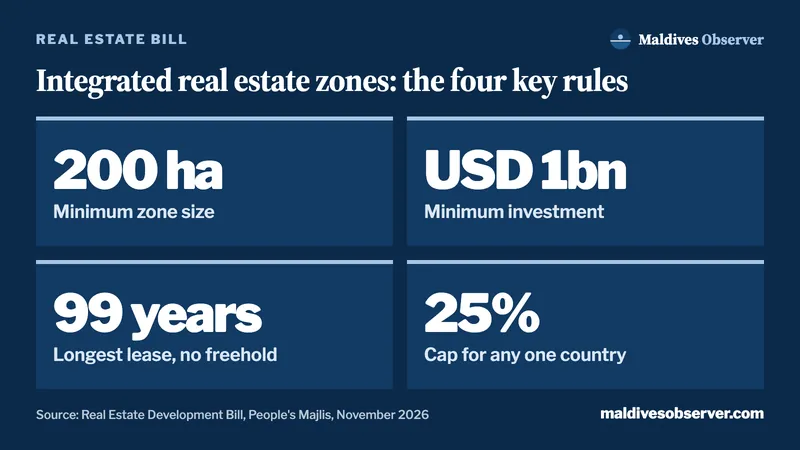
Chapter 8 of the bill sets out how the largest projects would work. The President may declare an area an integrated real estate zone (section 76). Each zone must cover at least 200 hectares and draw at least USD 1 billion of investment. It is developed by a single master developer under a master plan approved by the ministry (section 85).
| Term | What the bill says | Section |
|---|---|---|
| Who declares a zone | The President | 76 |
| Minimum size | 200 hectares | 76 |
| Minimum investment | USD 1 billion | 76 |
| Lease to the master developer | Up to 99 years | 78 |
| State's share | At least 10% of property sales, land rents, property rents and zone business income | 79 |
| Fee on each sale or transfer | 4% of the value | 80 |
| What buyers receive | Leasehold rights for up to 99 years, on a "surrender and re-grant" basis | 89 |
| Limit per nationality | No more than 25% of land or units to citizens or companies of any one country | 94 |
| Security | Provided by the state's security services | 96 |
The master developer can be a state-owned company, a Maldivian company, a foreign company or a joint venture (section 82). The ministry may choose one through an open bid, a direct proposal or a government-to-government arrangement (section 84).
How the bill protects state revenue and control
The state keeps a share of the money every zone earns. Section 79 sets a floor of 10% on four streams: the price of property the master developer sells, rent it collects on land, rent from property it lets, and income from businesses it runs in the zone. A separate fee of 4% applies to each sale or transfer of property in a zone (section 80).
Security stays with the state. Section 96 assigns policing and security in the zones to the state's security services, not to developers. Maldivian law applies in full, and the bill bars any activity in the zones that is contrary to Islam or to Maldivian law (section 98).
The 25% cap per country in section 94 is designed to stop any single nation's buyers from dominating a zone. Section 95 bars sales to citizens of any country whose nationals are not allowed to enter or live in the Maldives.
Leasehold, not freehold
Article 251 of the Constitution, as amended in April 2019, says no foreign party may own any part of Maldivian territory, and no foreign party may lease land for more than 99 years. The bill follows both rules. The master developer holds the zone on a lease of up to 99 years (section 78), and buyers receive leasehold rights for up to 99 years, not freehold title (section 89).
During the debate on 16 November, MP Ibrahim Shujau said the bill does not let foreigners own land and does not breach the Constitution. Opposition MDP members had argued that it opens the way to foreign land ownership. The bill's text gives leasehold rights only.
The government has said the same of Ras Malé. On 28 October the President said the project would give Maldivians "unprecedented access to secure housing over the next two years", and that major projects are financed through future revenue and land leases to avoid adding to debt. For the terms of the Ras Malé agreement itself, see what the Ras Malé deal with Eagle Hills promises the Maldives.
What happens next
The bill is at the debate stage. After the general debate it goes to committee, where it can be amended before a final vote. Speaking in the debate, MP Ibrahim Shujau said the bill would not be rushed and that the public would have a chance to give views.
Once passed, ratified and published in the Government Gazette, the Act takes effect on the day of publication (section 162). Existing developers would then have 90 days to register their projects with the new authority (section 159). The authority must issue its regulations within one year (section 160). Buyers who have a complaint could take it to the authority, and anyone who disagrees with the authority's decision could go to court within 30 days (section 148).
Explainers
- Maldives vape ban and tobacco rules: what is banned and what visitors can bring
- Maldives population: how many people live in the Maldives?
- Maldives currency explained: the rufiyaa, the US dollar rate and how visitors can pay