Maldives currency explained: the rufiyaa, the US dollar rate and how visitors can pay
The Maldives uses the rufiyaa, set by the central bank at MVR 15.42 to the US dollar. Tourists may pay in dollars under the Foreign Currency Act. Here is what the law says on paying, exchanging money and carrying cash.
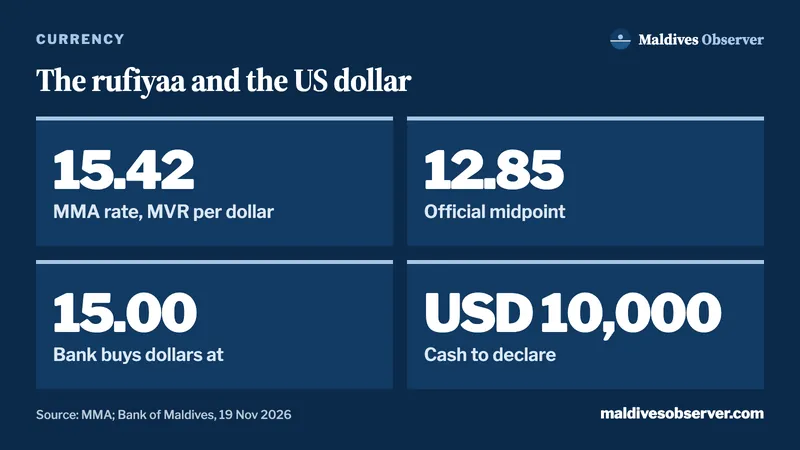
The currency of the Maldives is the Maldivian rufiyaa (MVR). The Maldives Monetary Authority (MMA) set its reference rate at 15.42 rufiyaa to one US dollar on 19 November 2026. Tourists can also pay in US dollars: the Foreign Currency Act lets businesses accept foreign currency for goods and services sold to tourists. For everyone else, and for everything else, the rufiyaa is the legal currency.
This guide sets out what the law and the central bank say about the rufiyaa, the dollar rate, exchanging money and carrying cash. Every figure comes from the MMA, the Foreign Currency Act, Bank of Maldives, the Maldives Inland Revenue Authority (MIRA) or Maldives Customs.
The rufiyaa at a glance
| Fact | Detail |
|---|---|
| Currency | Maldivian rufiyaa (MVR) |
| MMA reference rate | MVR 15.42 per US dollar (19 November 2026) |
| Official midpoint and band | MVR 12.85, allowed to move 20% either way: MVR 10.28 to MVR 15.42 |
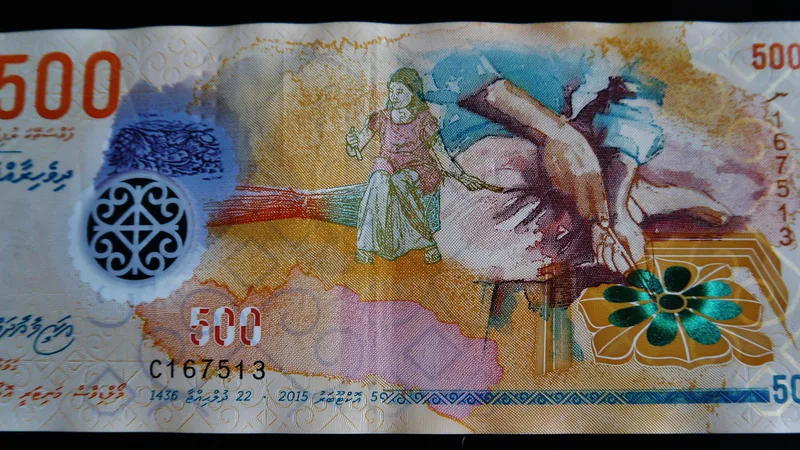
| Banknotes | Seven: 5, 10, 20, 50, 100, 500 and 1,000 rufiyaa, all polymer |
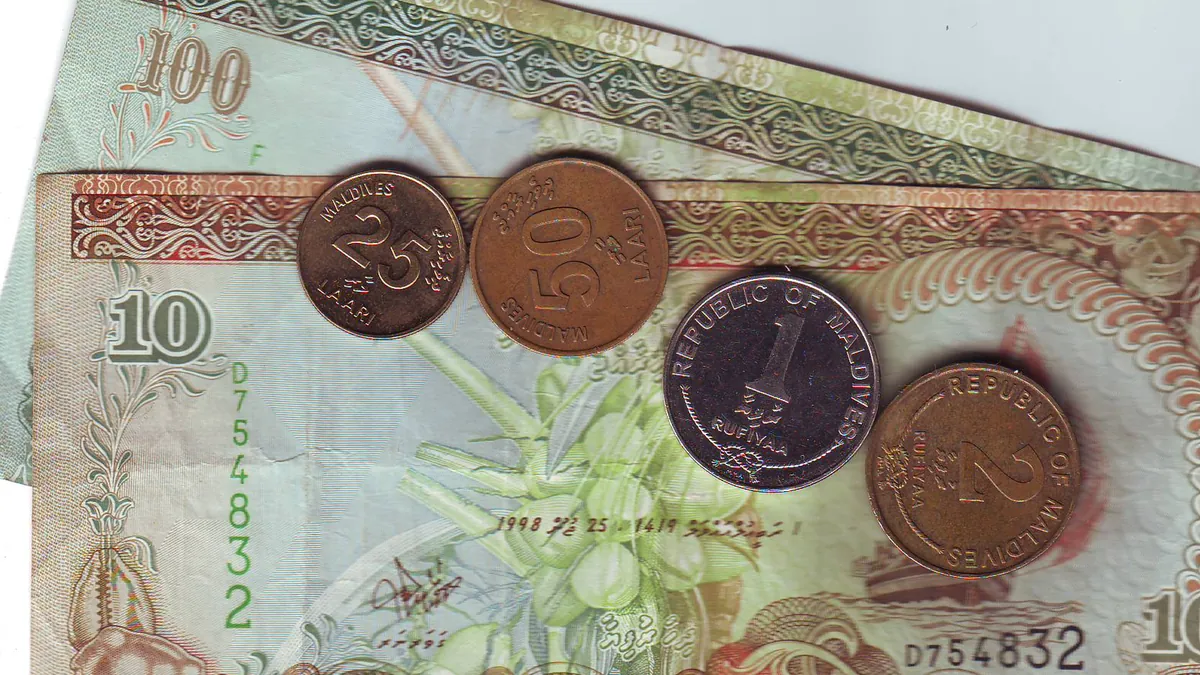
| Coins | Eight denominations in circulation, including 1 and 2 rufiyaa coins |
| Bank of Maldives dollar rate | Buys at MVR 15.00, sells at MVR 15.42 (19 November 2026) |
| Cash to declare at the border | USD 10,000 or more, or the same value in any currency |
Sources: Maldives Monetary Authority; Bank of Maldives; Regulation on Cross Border Cash Declaration Amount.
How the dollar rate is set
The rufiyaa does not float freely. The MMA says the midpoint of the exchange rate is MVR 12.85 per US dollar, and the rate may move within a band of 20% on either side, from MVR 10.28 to MVR 15.42. The dollar rate itself "is determined by the MMA". The current reference rate, MVR 15.42, sits at the top of that band.
Banks work inside the same band. On 19 November 2026 Bank of Maldives, the largest bank, bought US dollars at MVR 15.00 and sold them at MVR 15.42. The Observer dollar rate tracker follows the official rate over time.
Banknotes and coins
All rufiyaa banknotes in circulation belong to the Ran Dhihafaheh series, the third note series in the country's history. The name means "Golden Fifty" and marks the 50th anniversary of independence in 2015. The notes are printed on polymer, not paper.
- The 10, 20, 50, 100, 500 and 1,000 rufiyaa notes entered circulation on 26 January 2016.
- The 5 rufiyaa note followed on 10 August 2017.
- Coins include 1 and 2 rufiyaa pieces and smaller laari coins of 1, 5, 10, 25 and 50 laari.
The MMA says all coins issued by the government since 1960 remain legal tender.
Can you pay in US dollars?
Yes, if you are a tourist. The Foreign Currency Act, in force since 1 January 2025, makes the rufiyaa the default: all transactions in the Maldives must be offered and settled in rufiyaa unless a law says otherwise. One of the listed exceptions is "accepting payments in foreign currency for goods sold and services provided to tourists". A second exception covers duty-free shops.
Three points follow from the wording of the Act:
- A tourist means a foreigner who enters on a tourist visa.
- The Act allows a business to take dollars from a tourist. It does not oblige the tourist to pay in dollars. Rufiyaa is lawful for any purchase.
- Maldivians cannot be made to pay in foreign currency for goods and services bought in the country, apart from payments the state or financial institutions set in foreign currency under the law.
Resorts and guesthouses deal in dollars for a reason. The same Act requires tourism businesses to deposit their foreign-currency earnings in a Maldivian bank and to exchange a set share for rufiyaa. Our explainer on tourism dollars and the Foreign Currency Act covers those rules.
Taxes that are set in dollars
Several tourist taxes are fixed in US dollars by MIRA. The business or airline collects them and pays MIRA in dollars.
| Tax | Amount | In force since |
|---|---|---|
| Tourism GST | 17% of the bill | 1 July 2025 |
| Green tax, resorts, tourist vessels and larger hotels | USD 12 per person per day | 1 January 2025 |
| Green tax, hotels and guesthouses with 50 rooms or fewer on inhabited islands | USD 6 per person per day | 1 January 2025 |
| Departure tax, foreign passengers | USD 50 economy, USD 120 business, USD 240 first class | 1 December 2024 |
| Airport development fee, foreign passengers, Velana International Airport | USD 50 economy, USD 120 business, USD 240 first class | 1 December 2024 |
Source: Maldives Inland Revenue Authority. Children under two are exempt from green tax and departure tax. Airlines collect the departure tax and airport fee with the ticket on scheduled flights. The full list is in our guide to Maldives tourist taxes.
Where to exchange money legally
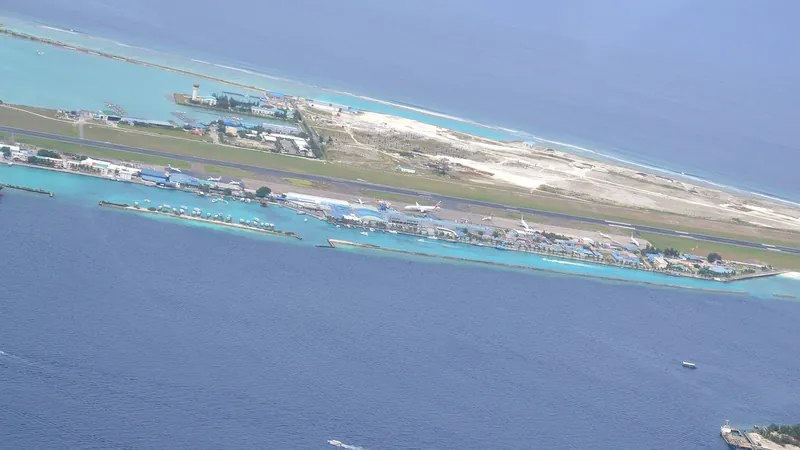
Foreign currency may be bought and sold only by banks and by money changers licensed by the MMA. The MMA list dated 9 September 2026 names 59 licensed money changers. It includes Maldives Airports Company Ltd, which runs Velana International Airport, the State Trading Organization and a number of resort operators.
Bank of Maldives publishes its rates daily. Two details matter to visitors:
- The bank accepts 13 currencies, among them the US dollar, euro, pound sterling, Indian rupee, Chinese yuan, UAE dirham and Singapore dollar.
- Small dollar notes get a lower rate. On 19 November 2026 the bank bought 10, 20, 50 and 100 dollar notes at MVR 15.00, but 1 and 5 dollar notes at MVR 10.28.
Since 1 September 2026 it has been an offence for anyone to sell foreign currency above the official rate or outside the band, or to advertise such a rate, including online. The fine for an individual who sells above the rate runs from MVR 25,000 to MVR 1 million. For a company it runs from MVR 100,000 to MVR 5 million. The government's stated aim is to bring foreign exchange into the banking system. Visitors should use a bank or a licensed counter.
Carrying cash in and out
The Foreign Currency Act permits people to bring foreign currency into and out of the Maldives and to hold it. The sources reviewed set no maximum. Large sums must be declared.
- Anyone entering or leaving with USD 10,000 or more in cash, or the same value in rufiyaa or any other currency, must declare it to Customs.
- On arrival by air, declare before the customs check or before entering the green channel. On departure, declare before the airline issues a boarding pass.
- Customs accepts the declaration on a form or online.
- Undeclared cash can be seized. The fine is 25% of the cash for a first case, 50% for a second and confiscation of the full amount for a third within five years.
Frequently asked questions
What is the currency of the Maldives?
The Maldivian rufiyaa (MVR). Notes come in 5, 10, 20, 50, 100, 500 and 1,000 rufiyaa, all polymer.
What is the Maldives currency to US dollar rate?
The MMA reference rate was MVR 15.42 per US dollar on 19 November 2026. The official midpoint is MVR 12.85, with a band from MVR 10.28 to MVR 15.42.
Can you use US dollars in the Maldives?
Tourists can. The Foreign Currency Act lets businesses accept foreign currency for goods and services sold to tourists. Rufiyaa is the default currency for all other transactions.
Where can I exchange money in the Maldives?
At banks and at the 59 money changers licensed by the MMA. Bank of Maldives bought dollars at MVR 15.00 and sold at MVR 15.42 on 19 November 2026.
How much cash can I bring into the Maldives?
The sources reviewed set no limit, but USD 10,000 or more must be declared to Customs on arrival and on departure.
For entry rules, transfers and local customs, see the Maldives travel guide for 2026–27.