Money changers in the Maldives: who is licensed, the MVR 50,000 cash limit and what your receipt must show
The Maldives Monetary Authority lists 59 licensed money changers outside the banks, under rules that cap cash deals and require a receipt with ID. On 18 November 2026 it fined and suspended three of them.
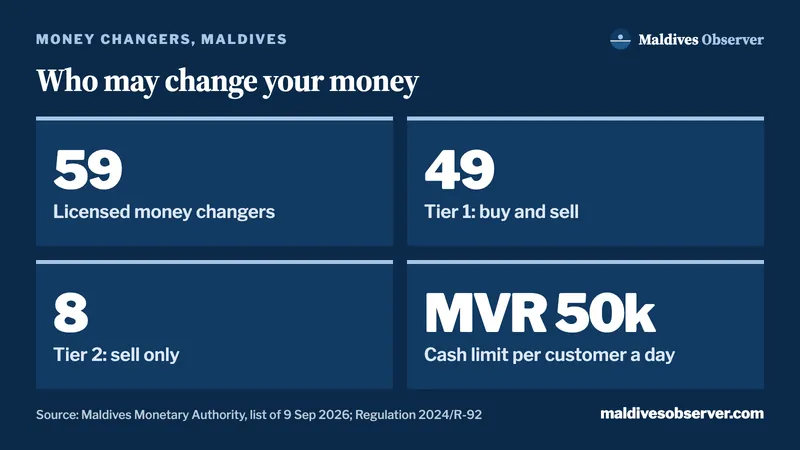
Outside the banks, only 59 businesses in the Maldives are allowed to buy or sell foreign currency. That is the number on the Maldives Monetary Authority's list of authorised money changers dated 9 September 2026. On 18 November 2026 the central bank fined three of them and suspended their licences for breaking the rules that govern the trade.
Those rules have changed a great deal in two years. A new Money Changing Business Regulation, No. 2024/R-92, was published in the Government Gazette on 1 October 2024 and amended by Regulation No. 2025/R-99 on 9 October 2025. It sets who may hold a licence, how much cash may change hands and what a customer must receive. For the rufiyaa itself and how the rate is set, see our Maldives currency guide and the dollar rate tracker.
Who holds a licence
The MMA says it is prohibited to deal in foreign exchange without a money changer licence that it has issued.
The regulation creates two tiers. A Tier 1 licence allows a business to buy and sell foreign currency. A Tier 2 licence allows it only to sell. The 9 September list breaks down as follows:
| Licence type | What it allows | Holders on the list |
|---|---|---|
| Tier 1 | Buying and selling foreign currency | 49 |
| Tier 2 | Selling foreign currency only | 8 |
| Older licence numbers | Maldives Airports Company Ltd and Universal Enterprises Pte Ltd | 2 |
| Total | 59 |
Source: Maldives Monetary Authority, list of authorised money changers as at 9 September 2026. Tier breakdown: our count of licence numbers.
The list includes the State Trading Organization. Tier 2 holders include several hotel and resort companies, which fits the rule that a Tier 2 licence lapses if the holder's licence under the Tourism Act is cancelled. Twenty entries also give a previous licence number, showing that those firms held licences before the new rules.
The list gives no addresses, so it does not show where each counter is. Tier 1 holders fall into two categories. Category A must work from an outlet that is easy for the public to reach. Category B may keep only an office and deal only by bank transfer.
What a licence costs and requires
According to the MMA's licensing page, an applicant must place a security deposit of USD 100,000 with the MMA before it starts trading. Tier 1 licences cost MVR 40,000 to apply for and MVR 48,000 a year. Tier 2 licences cost USD 2,600 to apply for and USD 3,600 a year. The annual fee is due by 31 January.
A licensed counter must also:
- display its MMA licence where customers can see it;
- put a sign outside with its name and the words "Licensed Money-Changer" in English, with the same wording in Dhivehi;
- show its buying and selling rates on a board at a Category A outlet, as the 2025 amendment requires;
- settle every deal on the same day, with no credit given either way;
- send the MMA a statement of its purchases and sales every quarter, by the 10th day of the following month, under a circular of 25 December 2025.
A Tier 1 money changer needs the MMA's approval before it changes its major shareholders, directors or compliance officer.
What customers need
A cash limit. A Tier 1 money changer may deal in cash with one customer for no more than MVR 50,000, or the same value in foreign currency, in a day. Larger amounts must go through a bank account in the customer's own name.
A receipt. After every purchase or sale the counter must give a receipt. It must show the customer's full name, the date, the currency and amount, the rate and an identity number. For individuals that means an identity card or passport number. For companies it means the registration number.
Identity checks. A separate anti-money-laundering regulation for money changers requires full customer checks on any deal of MVR 50,000 or more. Checks are also required whenever the counter suspects wrongdoing. The counter must record the customer's name, identity card, passport or visa number, address and nationality. It must keep the records for five years. It must also report cash deals of MVR 200,000 or more to the Financial Intelligence Unit each week.
Visitors should carry a passport, and residents an identity card, when they change money at a counter.
How the MMA has been enforcing the rules
The MMA has stepped up supervision under the new rules:
- Applications. It opened rounds for Tier 1 licences in February 2025, October 2025 and February 2026.
- 20 August 2026. It cancelled the licence of Express Money Exchange Pvt Ltd after supervision found breaches of the regulation.
- 9 September 2026. It warned the public that some parties were changing money without a licence, which is an offence. It asked people to deal only with banks or with a firm on its list.
- 18 November 2026. It fined LVR Investment Pvt Ltd and Myzone Exchange Pvt Ltd MVR 250,000 each, and Mad Money Exchange Pvt Ltd MVR 500,000. It also suspended all three licences from that day.
Other measures sit alongside these. A Foreign Currency Act amendment made it an offence from 1 September 2026 to sell currency above the official rate, as our currency guide explains. The deposit and conversion rules for tourism businesses are covered in our report on tourism dollars. The MMA Governor told Parliament on 10 November that the medical dollar scheme may change by January.
What happens next
The next quarterly statements from money changers are due by 10 January 2027, and annual fees by 31 January 2027. The MMA has said it will keep taking action against parties that break the rules, working with enforcement agencies.
The list of authorised money changers is published on the MMA website, most recently on 9 September 2026. Anyone offered a rate by a business that is not a bank should check that list first. The MMA licensing division can be reached on 301 2122 or at licensing@mma.gov.mv.
Related data
All data trackersExplainers
- Maldives currency explained: the rufiyaa, the US dollar rate and how visitors can pay
- Maldives vape ban and tobacco rules: what is banned and what visitors can bring
- Whale shark and manta ray season in the Maldives: where to go, when, and the rules