Essential goods in Malé cost 9.96% more than a year ago: what the ECPI measures and why the CPI is lower
The Maldives Bureau of Statistics essential commodities index for Malé rose 9.96% in the year to October 2026, led by meat, vegetables and coffee. Headline CPI is far lower because the essentials basket is mostly food and leaves out tobacco, which has become cheaper.
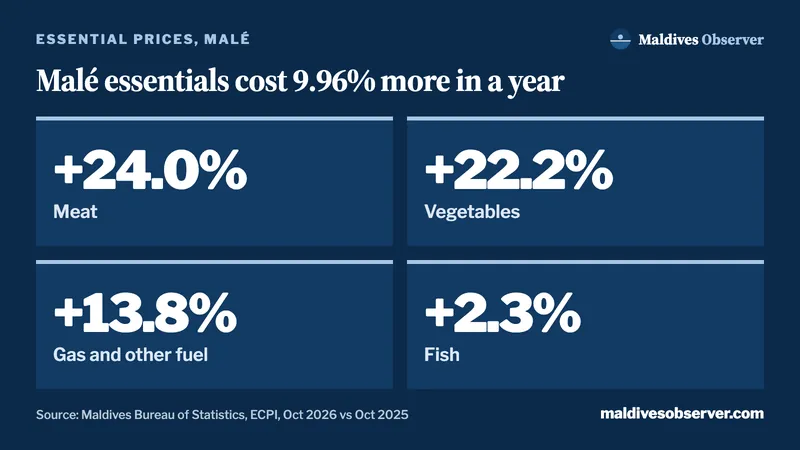
Essential goods in Malé cost 9.96% more in October 2026 than a year earlier, according to the Maldives Bureau of Statistics (MBS). Its Essential Commodities Price Index (ECPI) stood at 125.39 in October, up 1.01% on September. The bureau published the figures on 9 November 2026. The annual rate was 7.79% in September 2026 and 1.89% in October 2025.
The headline Consumer Price Index (CPI) tells a different story. In September 2026 the national CPI was 1.17% higher than a year before, and the CPI for Malé only 0.21% higher. Both come from the same bureau. The gap comes from what each one measures.
What the ECPI measures
The ECPI is a sub-index of the CPI. MBS describes it as a weighted average of the prices of 96 essential products in Malé, drawn from 2,549 price quotations collected each month. The Ministry of Economic Development and Trade helped choose the basket. MBS says the index is used for price regulation and as an early warning of rising prices for essentials.
The weights are what set it apart. Food carries 70.94% of the ECPI. Beverages carry 14.20%, personal care products 8.43%, and gas and other fuel 6.43%. Rent, electricity, transport, phone bills, tobacco, school fees and restaurant meals are not in it. In the full CPI, food and beverages make up just under a quarter of the basket, by our calculation from the MBS September tables.
Why one index is near 10% and the other near 1%
In the September CPI, MBS recorded food and beverages up 7.39% in Malé and 8.59% nationally. It named tobacco and areca nuts as the largest downward pull. That group was 33.89% cheaper in Malé than a year earlier. MBS attributes recent tobacco price falls to changes in import duties on tobacco products that took effect at the start of July 2026.
The Maldives Monetary Authority (MMA) has described the same pattern. In its first-quarter 2026 bulletin, it said consumer price inflation averaged 4.0% in 2025, "mainly reflecting the one-off impact" of higher tobacco taxes. That effect has since dropped out of the annual comparison. The ECPI excludes tobacco, so it shows the food increase in full.
Food also accounts for most of the ECPI rise. Using the MBS weights and group indices, food contributed about 7.8 percentage points of the 9.96% increase. Beverages added about 1.0 point, gas and other fuel 0.7 and personal care 0.4.
Which items moved
| Group (MBS classification) | Index, Oct 2026 (Nov 2022 = 100) | Change on Oct 2025 |
|---|---|---|
| All essential commodities, Malé | 125.39 | +9.96% |
| Food and beverages | 127.28 | +10.22% |
| Food | 129.83 | +10.73% |
| Meat | 136.93 | +23.97% |
| Coffee and coffee substitutes | 150.18 | +23.22% |
| Vegetables | 127.30 | +22.16% |
| Fruit | 144.92 | +13.24% |
| Milk, other dairy products and eggs | 128.92 | +12.11% |
| Sugar, jam, honey, chocolate and confectionery | 126.13 | +10.63% |
| Oils and fats | 122.78 | +10.20% |
| Cereals and cereal products | 113.19 | +4.77% |
| Fish | 131.39 | +2.28% |
| Water | 101.18 | 0.00% |
| Gas and other fuel | 106.70 | +13.82% |
Source: Maldives Bureau of Statistics, ECPI October 2026, Tables 1 and 3.
The monthly series shows when the increases happened. The gas and other fuel index rose 12.48% in March 2026 and has not changed since April. Meat rose 14.58% in April and 6.68% in May, then levelled off. Vegetable prices swing from month to month: up 20.86% in June, down 10.89% in July and up 9.80% in September. Part of the vegetable figure is a base effect. In October 2025 vegetable prices were 10.1% lower than a year before that.
In October alone, fruit rose 3.32%, cereals 1.92% and oils and fats 1.38%. Vegetables fell 0.38% and fish 0.31%.
The official explanation
The MMA links the rise to events abroad. In its first-quarter bulletin, published on 30 July 2026, it said the closure of the Strait of Hormuz after the outbreak of war in the Middle East on 28 February 2026 had disrupted global supply chains. It said energy prices had risen sharply, "with pass-through effects expected on domestic production costs and consumer prices". It flagged an upward revision to its 2026 inflation forecast. It said the risks lie mainly in oil and food prices in the markets the Maldives imports from.
The MMA's July 2026 Economic Update reported that import spending rose 26% in May 2026, with petroleum products, construction items and food among the main drivers. Import bills are paid in US dollars; our report on official reserves in October 2026 has the latest reserve figures.
What the government says it is doing
The government set up a Special Cabinet Committee on the Middle East situation. At a briefing at the President's Office on 7 April 2026, its chair, Foreign Minister Dr Abdulla Khaleel, said the government had tracked the situation since 28 February. He said it was identifying alternative markets for essential goods in case supplies were disrupted. Economic Development and Trade Minister Mohamed Saeed said 164 essential items were monitored daily and no shortages had been recorded. He said talks were under way with the State Trading Organisation (STO) and Villa Gas after Villa Gas raised the price of liquefied petroleum gas. The Tourism and Environment Minister said there were no plans to raise electricity tariffs.
On 11 October 2026 the trade ministry said President Dr Mohamed Muizzu had approved an expansion of the national essential items list from 26 to 80. The list now covers 20 fruits, 20 vegetables, 37 household food items and three non-food items. STO imports the goods and sells them through designated agents and local shops. The ministry said the aim is to keep the same STO prices on every inhabited island.
Subsidy spending has also risen. The Ministry of Finance and Public Enterprises reported subsidy spending of MVR 4.59 billion from 1 January to 12 November 2026. That compares with MVR 3.04 billion in the same period of 2025 and MVR 2.89 billion approved for the whole of 2026.
For the longer run of headline inflation, see our inflation data page.
What happens next
MBS will publish the October 2026 CPI on 30 November 2026. It will show how much of the food increase is reaching the headline rate. The November 2026 ECPI is due on 9 December 2026, according to the release calendar in the October bulletin. November is the first full month since STO began distributing the 80-item list.
Related data
All data trackersExplainers
- Maldives population: how many people live in the Maldives?
- Maldives public holidays 2027: tentative list, long weekends and school calendar
- Maldives tourist arrivals by year and by country