Maldives state pay framework explained: how salaries are set and what protects take-home pay
The pay framework puts state employees on one structure of basic salary, job allowance and attendance benefit, aiming for fair pay across the state. A migration allowance covers anyone whose pay would fall after the move.

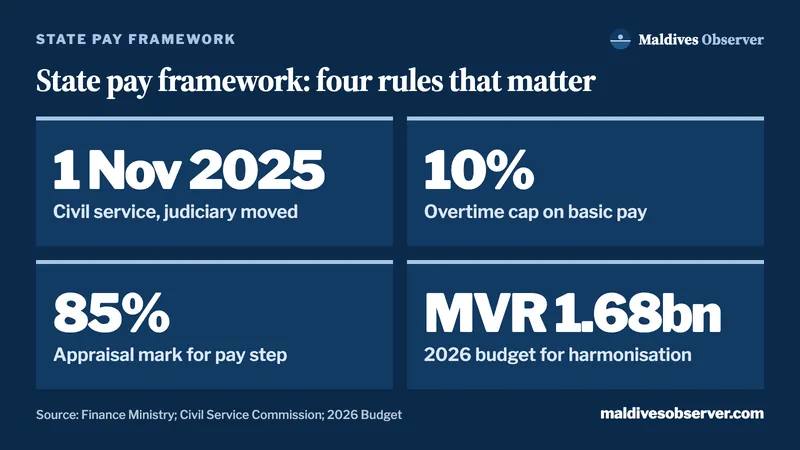
The state pay framework that moved civil servants and judicial staff to new salaries on 1 November 2025 is now a fixed part of public spending, and it is back in view as the People's Majlis reviews the 2027 budget. The framework sets one structure for pay across state institutions. Its stated purpose, written into the National Pay Policy Act, is to reduce gaps in pay between skills, classes and levels and to give public servants "dignified living by way of real wage and benefit". The government's 2026 budget set aside MVR 1,683.8 million for the change.
Finance Minister Hassan Zareer presented an MVR 59.7 billion budget for 2027 on 29 October 2026, about MVR 4.5 billion less than the budget approved for 2026, with no new taxes. For the main numbers, see our guide to the Maldives budget for 2027.
The law and the commission
The framework rests on the National Pay Policy Act (Act No. 11/2016). The Act creates a five-member National Pay Commission. The finance minister chairs it, and the President appoints the other four members, who serve part-time for five-year terms. Mr Zareer is the commission's president, according to the ministry's website.
The Act lists the aims. Pay should raise productivity, narrow differences between skills, classes and levels, and stay within what the state can afford. It allows pay to differ by profession, risk and location.
Who has moved, and when
The government began rolling out pay harmonisation in 2022. Teachers, doctors, police and military personnel moved first, according to the 2026 budget. On 28 September 2025 President Dr Mohamed Muizzu announced that Civil Service, Judicial Service and Local Government employees would move to the harmonised structure from 1 November 2025, with all pending increments included. He said increments for institutions not yet covered would follow in 2026. The 2026 budget planned for independent institutions, uniformed bodies and other public-sector staff to move during that year.
How pay is set
Under the Pay Framework Standards, pay for a post has two parts: a basic salary and a job allowance. An attendance benefit is paid on top. Posts sit on public service ranks 1 to 12. The basic salary for each post is fixed in a job matrix for its profession. The National Pay Commission publishes matrices in eight service groups, from health and education to protective services and skilled and elementary work.
Pay rises inside a post come through steps in the job allowance, from step 1 to step 2 and then step 3. The standards set a benchmark: two years in a row with an appraisal mark of at least 75%. For civil servants, the Civil Service Commission has set the bar at 85% in two consecutive years. Its policy was first issued on 15 October 2025 and amended on 7 January 2026 and again on 23 August 2026. The latest version also requires at least 90 days of work in an appraisal year.
| Rule | What it says |
|---|---|
| Pay structure | Basic salary plus job allowance, set per post in job matrices; ranks 1 to 12 |
| Step progression | Benchmark of 75% appraisal marks for two years; 85% for civil servants |
| Overtime | Monthly overtime pay capped at 10% of basic salary, with set exceptions |
| Attendance benefit | A fixed daily amount for each day at work; not paid for leave or absence |
| Migration allowance | Paid where pay and allowances fall after the move |
Source: Pay Framework Standards, consolidated 9 June 2026; Civil Service Commission policy, 23 August 2026.
Overtime and attendance
Two rules change how take-home pay is built. First, overtime paid in a month may not exceed 10% of basic salary. Some days, such as the last ten days of Ramadan, are treated separately. Second, the attendance benefit is a fixed daily amount set in the job matrix and paid for each day an employee comes to work. It is not paid for days on leave or absence.
Together, the two rules move income away from long overtime hours and towards a set salary that is the same for the same post in different institutions.
What protects existing pay
A question asked of any pay reform is whether anyone ends up with less. The framework answers this in its own rules. A Migration Allowance Standard (478-NPC/2025/ST-26) applies where an employee's salary and allowances fall after moving onto the framework. It compares the new pay with an average of at least six months of the old pay: basic salary, fixed monthly allowances and daily attendance payments. Overtime and temporary allowances are not counted. The difference is paid as a migration allowance, and the National Pay Commission decides any case outside these terms.
What it costs
The 2026 budget book puts the cost of pay harmonisation at MVR 1,683.8 million. That is 75.3% of the MVR 2,236.2 million rise in salaries and wages for 2026. The Finance Ministry estimated that, once all state employees have moved, spending on salaries and allowances will rise by about MVR 2.6 billion a year. It said it expects the change to raise efficiency, so the state can keep the same size of workforce.
In his address to the Majlis on 5 February 2026, the President said staff expenses in 2025 were MVR 14.2 billion, including the pay harmonisation that took effect in November 2025. For how state pay sits against wages across the economy, see our explainer on the minimum wage and average salary in the Maldives.
What happens next
- The 2027 budget vote. The Majlis is reviewing the budget before it votes. The final salary allocation will show how much of the full-year cost of the framework it carries.
- The last institutions to move. The 2026 budget planned for remaining state bodies to join during 2026. We could not find a published list of the bodies still to move.
- Appraisal season. The 2026 appraisal results will decide which civil servants qualify for their next pay step under the 85% rule.
Related data
All data trackersExplainers
- Maldives budget 2027 in numbers: revenue, spending, deficit and debt
- Maldives currency explained: the rufiyaa, the US dollar rate and how visitors can pay
- Maldives public ferry and bus guide: RTL routes, fares and how to book