Muizzu's Republic Day address: past reforms that met doubt, and a call for a 'civilised society'
President Muizzu's Republic Day address on 19 November 2026 recalled four reforms that once met resistance and set out a development policy built on Islam, human development and physical progress. It proposed the motto "Dhivehinge Raajje – Civilised Society".
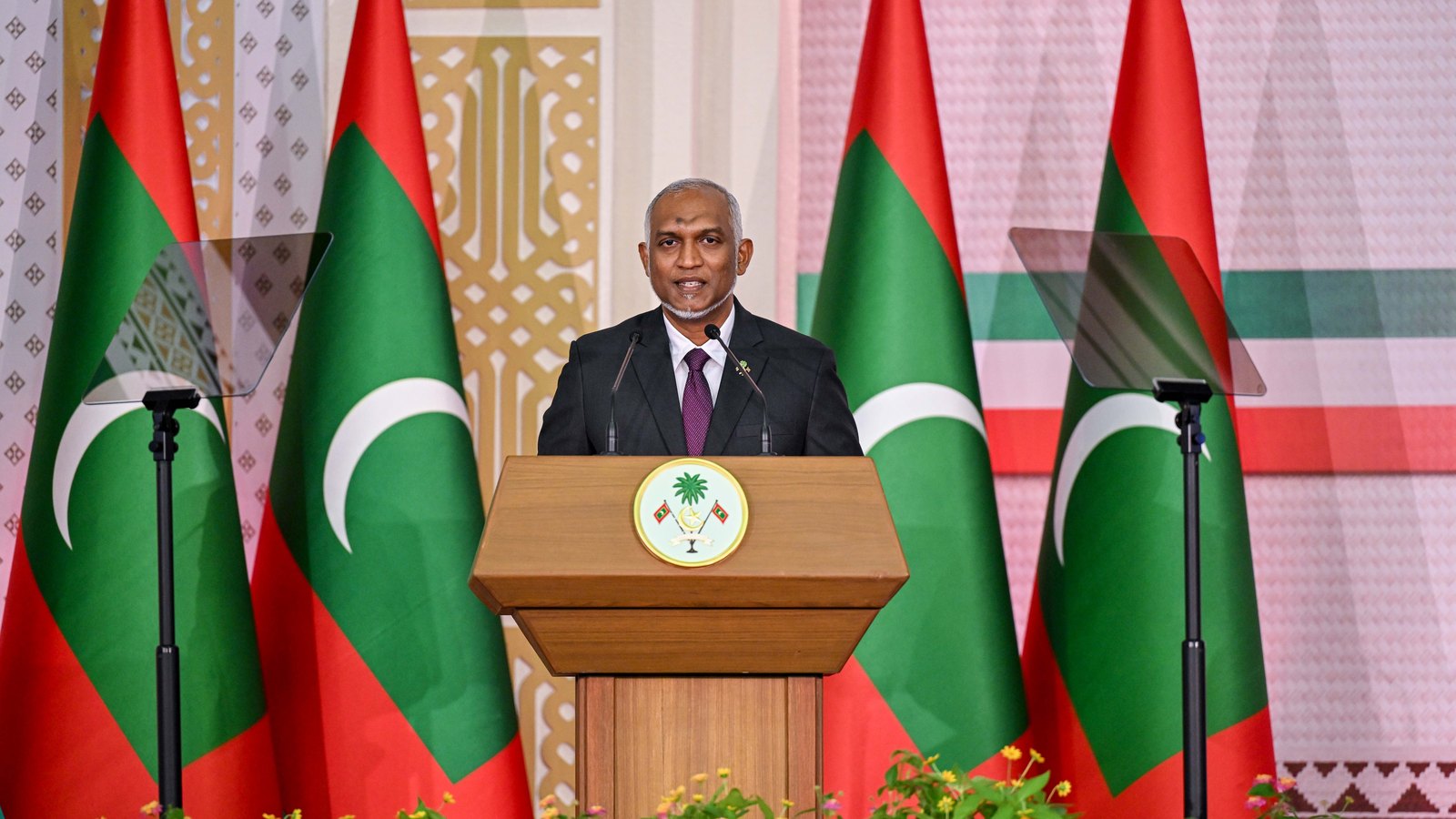
President Dr Mohamed Muizzu used his Republic Day address on 19 November 2026 to set out a single national aim: a "civilised society" built on Islam, human development and physical progress. He offered the motto "Dhivehinge Raajje – Civilised Society" for it. The speech, delivered at the official ceremony held at the Maldives Centre for Social Education (MCSE), contained no new spending figures or targets. Instead it made a historical case: that Maldivians have backed reform each time it was doubted, and that the country should do so again.
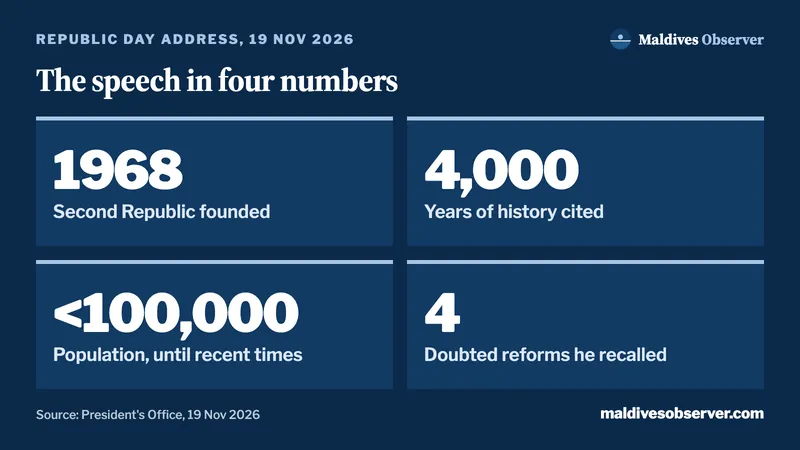
Republic Day falls on 11 November and marks the founding of the Second Republic in 1968. The President's Office published the speech in Dhivehi, reference SA/RMM/2026/47, with three English summaries the same night. The address came two days after the President marked three years in office with a review of the government's record. Our three-year data check covers that review.
A republic as a democratic choice
The President began with a definition. A republic, he said, is government by a leader chosen through the decision of the majority, which in today's language means democracy. Republic Day is therefore the day Maldivians spoke on how the state should be run.
For most of its 4,000 years the country had fewer than 100,000 people, he said, yet it defended its islands and kept its independence. Maldivians embraced Islam early in its spread. The Dhivehi text says they adopted the first complete written constitution in the region. Government then moved from absolute monarchy to elected monarchy, then to a republic, and finally to modern democratic principles. In the President's reading, each step showed a people able to choose the system that served the nation best.
Four reforms that met resistance
The core of the address was a list of changes that met objections at the time and are now taken for granted. The President used them to argue that most Maldivians have always put national vision and progress first.
| Reform | Leader the President credited | Objection he recalled | Outcome he described |
|---|---|---|---|
| Schooling for girls | Al Ameer Mohamed Amin, first President | Some said educating girls was improper | Made law through a bill in the People's Majlis; benefits now nationwide |
| Wide roads on islands | Mohamed Amin | Opposition to replacing narrow lanes | Islanders built the roads themselves |
| Engines on fishing dhonis | Ibrahim Nasir, first President of the Second Republic | Claims that engine noise would drive fish away | Lh. Naifaru's dhoni Ummeedhu led the way; fisheries advanced |
| Tourism | Two or three Maldivian pioneers | A foreign feasibility study said scattered islands ruled it out | Now the largest pillar of the economy |
Source: President's Office, Republic Day address and English summaries, 19 November 2026.
On tourism, the Dhivehi text adds that some neighbouring countries had organised the industry by around 1966. The President asked listeners to judge each reform by its results.
Two foundations for development policy
The President then stated the basis of his own policy. His administration's development policy, he said, rests on two points, both grounded in Islam: spiritual and human development, and physical and urban development. The aim is a new era rooted in Maldivian national identity.
He described the society he wants in some detail. It should guard its independence and sovereignty on a strong Islamic foundation, secure prosperity for individuals and the nation, and withstand climate and global shocks. It should be inclusive and cohesive, with an innovative and productive economy and a healthy, educated and skilled population. Optimism, harmony and unity, he said, drive national progress.
The motto he proposed echoes the name of the administration's programme. The President's Office lists that programme as the Dhivehinge Raajje Manifesto 2023–2028.
How the themes match the record
The Republic Day speech gave no numbers of its own. The President had, however, set out figures for several of these themes at the third-anniversary ceremony at Central Park, Hulhumalé, on 17 November 2026.
- An educated and skilled population. The share of students moving on to higher secondary education rose from 37% to 46% in three years. The country's first vocational school has 121 students.
- A productive economy. Lui loans have reached 4,061 young people in three years. Small and medium businesses will pay no duty on imported raw materials from 1 January 2027; the point at which a business must register for GST moves up to MVR 1.5 million on that date.
- Fisheries, the sector of the engine story. Fishermen have been paid MVR 2.3 billion, of which MVR 1.3 billion was paid within 48 hours of sale.
- Physical and urban development. Roughly 4,000 homes are under way in Greater Malé, and reclamation at Rasmalé has reached some 800 hectares.
- Sovereignty and values. The President said on 17 November that investments contrary to Islam, the country's sovereignty or its values will not be permitted.
The speech's theme of doubt ties to the same event. On 17 November the President called concerns about the Rasmalé project "unfounded". On 19 November he recalled earlier reforms that were doubted at first and later accepted. He closed by asking citizens to renew their commitment to a peaceful and prosperous future.
Honours at the same ceremony
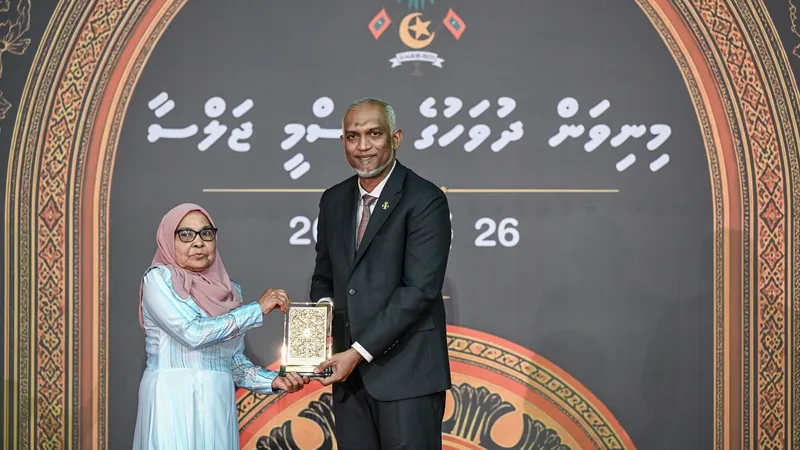
The President also presented the state's highest honours for service. Dr Mohamed Rasheed Ibrahim received the highest honour for Islamic awareness and religious service, and Abbas Ibrahim the highest honour for Dhivehi language and literature. Another 113 people received national awards: 56 for public service and 57 for special achievement. The recipients are listed in our national awards report.
What happens next
The administration's term, and its manifesto, run to 2028. The first tests of the economic themes come on 1 January 2027, when the import-duty exemption for small business raw materials and the higher GST threshold take effect. The President has also said the government aims to bring debt below its 2023 share of GDP by the end of 2028. For background on the office and its powers, see who is the President of the Maldives.
Explainers
- Who is the President of the Maldives? Muizzu, the Vice President and the cabinet
- Maldives public ferry and bus guide: RTL routes, fares and how to book
- Maldives public holidays 2027: tentative list, long weekends and school calendar