Muizzu's investment rule explained: what Islam and sovereignty limits mean for investors in the Maldives
President Mohamed Muizzu said on 17 November 2026 that investments contravening Islam, sovereignty or Maldivian values will not be permitted. The limits already sit in the Constitution, the 2024 Foreign Investments Act and the Special Economic Zones Act.
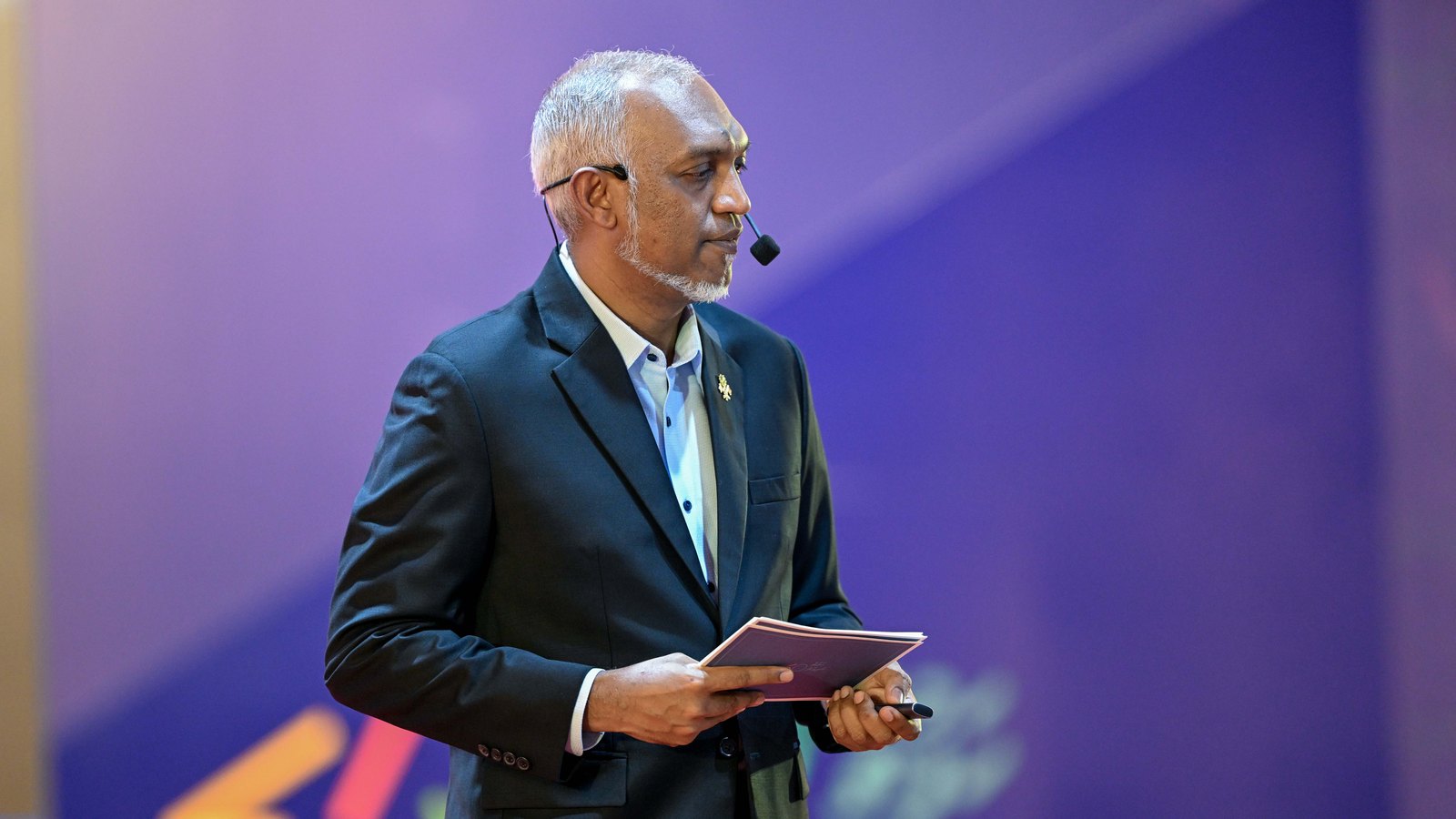
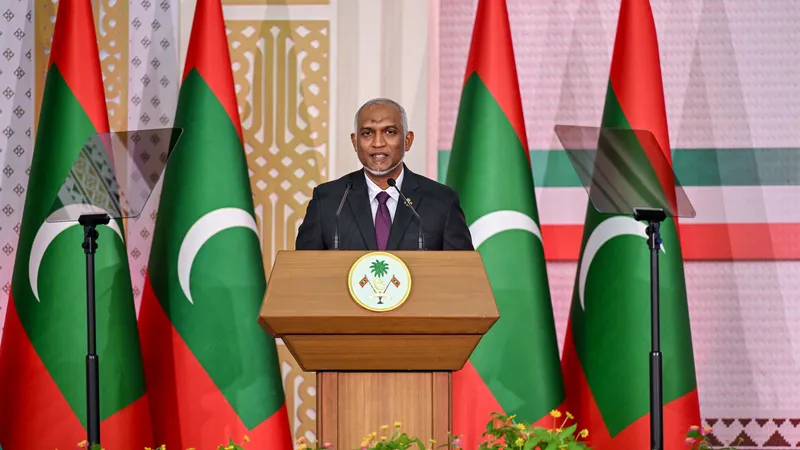
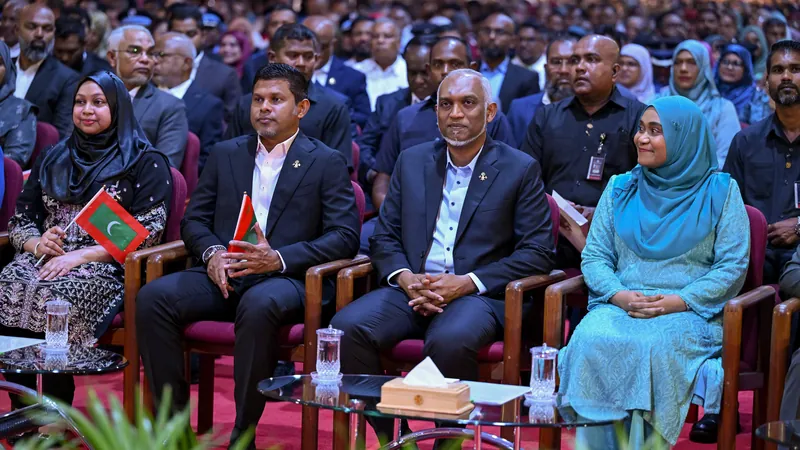
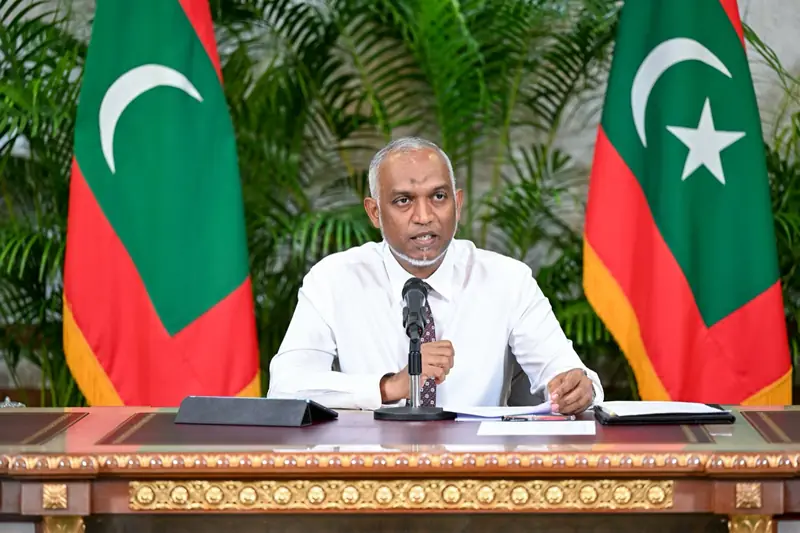
President Mohamed Muizzu said on 17 November 2026 that the Maldives will not permit any investment that goes against Islam, the country's independence and sovereignty, or Maldivian values. Investment opportunities, he said, remain open to partners who respect and uphold those principles. He spoke at the ceremony marking three years in office, the President's Office said the same day.
He described this as a position the government has kept from the start. For investors, it restates limits already written into the Constitution, the 2024 Foreign Investments Act and the Special Economic Zones Act; it does not add a new licensing step.
What the President said
The President said investors are expected to honour the customs and values Maldivians hold dear, and that anyone not prepared to do so has no place investing here. His government, he said, will allow nothing that weakens the country's independence, its sovereignty or its social values.
He also set out spending priorities at home:
- Housing takes a large part of the budget, and next year's focus is on finishing key projects.
- Essential services (water and sewerage, banking, policing and waste management) will reach every inhabited island, whatever its size or location.
- Urban Centres and Integrated Development Zones will complement this with enhanced services.
- Spending on them is a long-term strategic investment, not waste, he said; basic infrastructure is every citizen's right.
The Finance Ministry said on 29 October 2026 that the 2027 budget sets aside MVR 3 billion for housing development projects and MVR 750 million as equity for housing loan schemes. For the wider record of the three years, see our data review of the government's first three years.
Where the rule sits in law
| Law | Provision | What it says |
|---|---|---|
| Constitution (2008) | Article 2 | The Maldives is a sovereign, independent, democratic republic based on the principles of Islam |
| Constitution (2008) | Article 10 | Islam is the religion of the State; no law contrary to any tenet of Islam may be enacted |
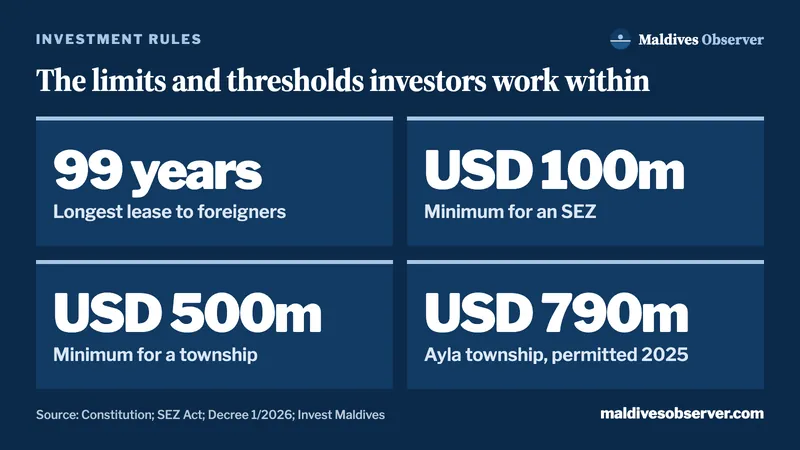
| Constitution (2008) | Article 251 | Foreign parties cannot own Maldivian land; any lease to them is capped at 99 years |
| Foreign Investments Act (11/2024) | Section 30 | Investor protections do not stop the State restricting an investment to uphold sovereign power, defence and security, the environment, human rights, or in a disaster or epidemic |
| Special Economic Zones Act (24/2014) | Section 77(c) | Zone matters may be restricted by law to preserve sovereignty, defence and territorial integrity, enforce Maldivian law, or protect Islam and national cultural values |
Sources: Constitution, English translation published by the President's Office; Foreign Investments Act and Special Economic Zones Act, as published by the Ministry of Economic Development, Transport and Trade.
Section 30 adds that such a measure must not single out one investor and must go no further than needed. Section 31 allows the State to take over an investment only for a stated public purpose or security need, with fair compensation. The President's Office said on 3 September 2024, when the Act was ratified, that it replaced the 1979 foreign investment law and takes precedence over other foreign investment laws, except the Special Economic Zones Act.
What it means for an investor
Under the 2024 Act, a foreign investment needs prior approval and a licence from the economic ministry. The ministry's six-step process covers an application, review, a no-objection letter with a draft Foreign Investment Agreement, a USD 5,000 fee paid to the Maldives Inland Revenue Authority, business registration, then the licence and signed agreement.
The ministry's sector list shows which activities are open to full foreign ownership, which are limited to joint ventures or capped stakes, and which are closed to new foreign investment, each with a minimum investment. A proposal that fits these rules and the Constitution is the kind of partner the President called welcome.
Larger projects can use the Special Economic Zones route. Under Presidential Decree 1/2026, issued on 27 January 2026, zone projects must invest at least USD 100 million in one of nine strategic areas, including ports, renewable energy and food security. A separate "sustainable township" category, added by an amendment ratified on 10 November 2025, requires at least USD 500 million, at least 60 per cent renewable energy, and facilities for training, healthcare and food production. Invest Maldives said township incentives include an income tax rate of 5 per cent for ten years and 10 per cent for the next ten, while GST, Green Tax and lease rent remain payable.
Recent approvals
Two zone projects have reached signed investment agreements, according to Invest Maldives:
- Project Solar City, a 100-megawatt floating solar plant about 4 km off Hulhumalé, valued at more than USD 100 million. It received its full zone permit on 12 February 2025, the first under the framework, and its agreement was announced in July 2025.
- Ayla Sustainable Township in Noonu Atoll, valued at more than USD 790 million. It received the first township permit on 9 December 2025, signed its agreement on 31 December 2025 and broke ground on 29 January 2026. It is expected to create more than 1,200 jobs.
Two larger schemes this year are covered separately: the Ras Malé agreement with Eagle Hills and the Maldives Economic Gateway agreement at Ihavandhippolhu.
How it fits the investment drive
The government presents foreign capital as central to Vision 2040 and to diversifying the economy beyond tourism. Economic Minister Mohamed Saeed told a business roundtable in Berlin on 10 February 2026 that the government is committed to a transparent, investor-friendly environment.
Some critics have questioned the Ras Malé project. The President said on 17 November that misinformation about it was being circulated and that concerns about the project were unfounded.
What happens next
The Special Economic Zones Act requires the President to review zone activities and thresholds each year before February, so the next decree is due by early 2027. Parliament is considering the 2027 budget. The President's Office has not said whether the investment principles will be written into any new guidance or regulation.
Explainers
- Who is the President of the Maldives? Muizzu, the Vice President and the cabinet
- Maldives vape ban and tobacco rules: what is banned and what visitors can bring
- Maldives currency explained: the rufiyaa, the US dollar rate and how visitors can pay